The bear case on AI infrastructure spending rested on a simple premise: if a Chinese lab could do frontier-quality inference for almost nothing, then every dollar the hyperscalers were committing to GPU clusters was a dollar chasing a commodity. That argument got considerably more complicated on August 6, 2026.
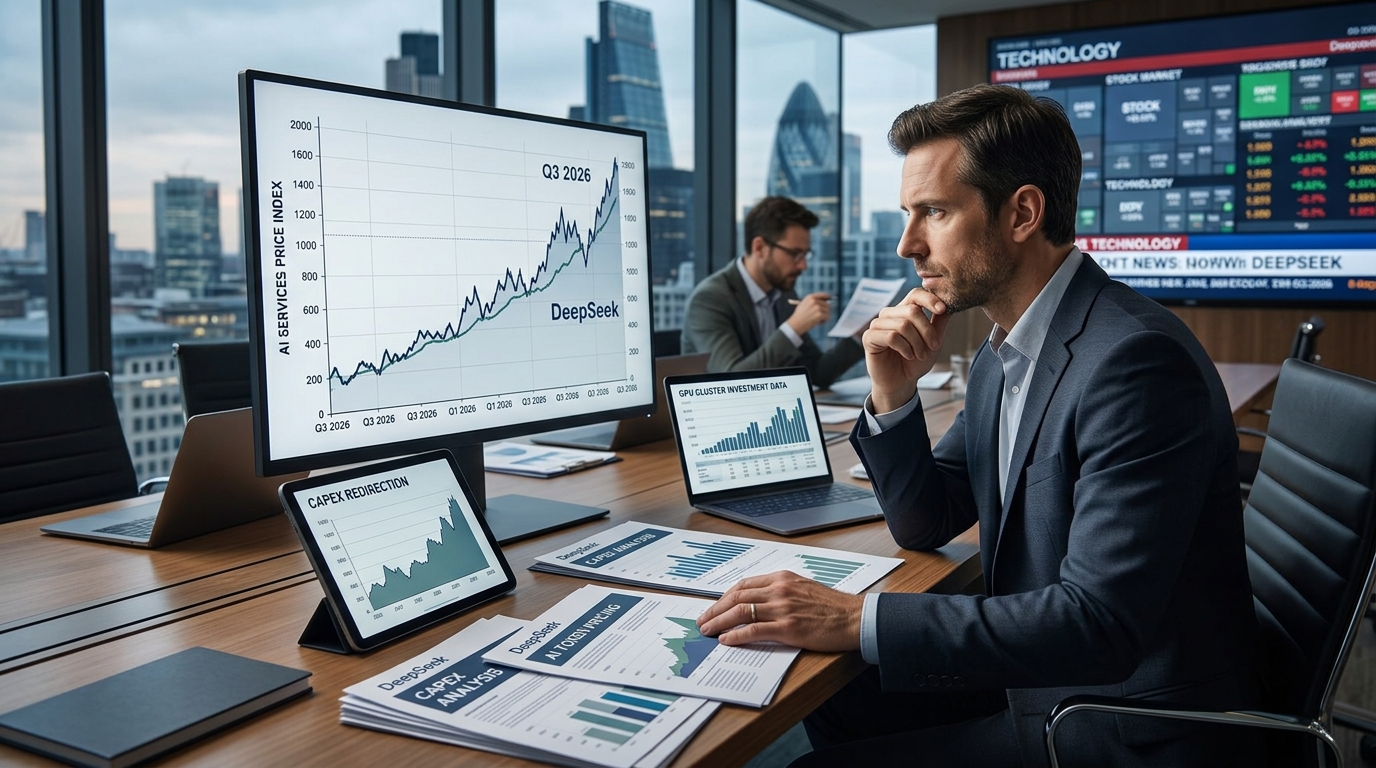
DeepSeek said in a notice posted on August 6 that prices across its AI services would rise substantially and urged users to plan accordingly, but did not specify the exact increases. Then the actual increase landed. Effective August 16, 2026, DeepSeek began billing on a peak and off-peak structure: V4-Flash runs $0.44 in and $1.32 out per million tokens during peak hours, and $0.22 in and $0.66 out during all other hours. That is still cheap. It is not free.
The pricing context matters for the investment debate. DeepSeek’s V4-Flash had been charging $0.14 per million input tokens and $0.28 per million output tokens. Against OpenAI’s GPT-5.5 at $5 input and $30 output per million tokens, the gap at the extreme was still roughly 98% to 99% on output. Even at the new peak rate, V4-Flash output remains about 23 times cheaper than GPT-5.5 on a per-token basis, and about 45 times cheaper off-peak. So the discount survives; the cheap-forever story does not.
Why did DeepSeek raise prices? The answer is the same reason the US hyperscalers keep raising their own capex guidance: compute is expensive. Reuters reported in early June 2026 that DeepSeek was set to raise about 50 billion yuan ($7.4 billion) in its first funding round, valuing it after the investment at roughly $52 billion to $59 billion. Separately, Bloomberg reported in late July 2026 that DeepSeek was planning a 1-gigawatt data centre in Ulanqab, Inner Mongolia. A 1GW data centre equipped with the most cutting-edge AI accelerators has been estimated at around $50 billion in investment in some industry reporting, though costs in China are typically lower. You cannot build that kind of infrastructure while pricing output tokens below a tenth of a cent. Operating models as loss leaders is no longer sustainable when capacity is tight and the infrastructure commitments are long-dated.
This is where the investment committee debate splits into two camps tonight, the same evening Nvidia reports fiscal Q2 2027 earnings. Consensus expects about $91.9 billion in revenue and $2.08 EPS from a company whose stock is trading around $208. The question is not whether Nvidia beats. What decides the stock is not whether Nvidia clears $91 billion. It is the Q3 guide, and a China number management deliberately left out.
Camp one: token deflation is an application-layer margin story, not a capex story. The hyperscalers are not buying GPUs so developers can sell inference cheaply. They are building capacity because they are supply-constrained, and demand keeps widening. Recent consensus estimates and third-party compilations put 2026 capex for the four largest hyperscalers at roughly $700 billion-plus, with some estimates clustering around $725 billion, up sharply from 2025. Separate analyst and ratings commentary has said that 2027 spending could approach or exceed $1 trillion, depending on which companies and categories are included. If cheap Chinese inference were genuinely killing the ROI case, those numbers would be compressing, not expanding.
Camp two: the application layer is where the margin risk lives, and DeepSeek’s price hike is a temporary reprieve, not a structural change. DeepSeek’s move reflects a broader trend in China’s AI industry, with startups moving away from the extremes of price wars toward sustainable, long-term revenue models. The cost floor keeps falling regardless of who sets the list price today. If API costs trend toward zero over a multi-year arc, the question for Microsoft, Google, and Anthropic is whether applications can capture the value that inference gives away.
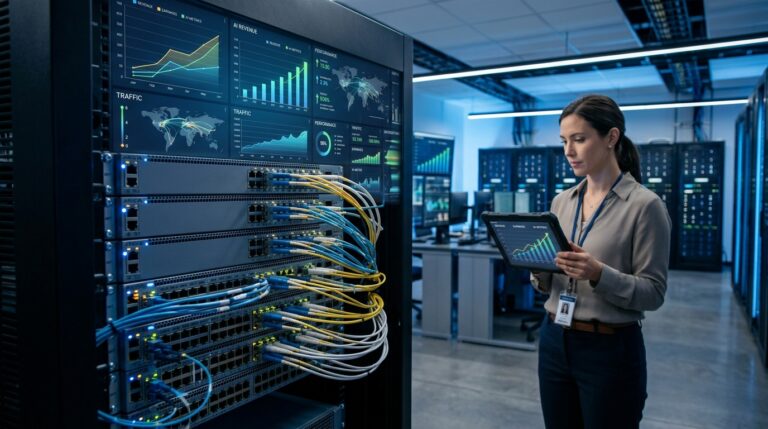
The part of this debate that deserves more attention: DeepSeek’s price hike is arguably more bullish for Nvidia than for the US model vendors. A DeepSeek that needs a 1GW data centre and is raising prices to fund it is a DeepSeek that requires serious compute at scale. Reuters reported in February 2026 that a senior Trump administration official alleged DeepSeek trained a model on Nvidia’s Blackwell chips at its Inner Mongolia-based facility, raising questions about U.S. export controls; Nvidia has said it complies with export rules, and DeepSeek has not publicly confirmed the allegation. But whether or not that is true, the underlying dynamic is clear: the lab that was supposed to make GPUs obsolete is now the lab building one of the largest data centres on the planet.
Stocks to watch: Nvidia (NVDA) reports tonight. The guide matters more than the quarter. Microsoft (MSFT) and Alphabet (GOOGL) are the clearest proxies for whether the application layer monetises the falling cost of inference. Alibaba (BABA) sits at the intersection: a hyperscaler building out its own cloud while competing Chinese AI models reset the cost base beneath it. And Anthropic, still private, is the clearest test of whether a premium-priced US model survives the squeeze from both ends.