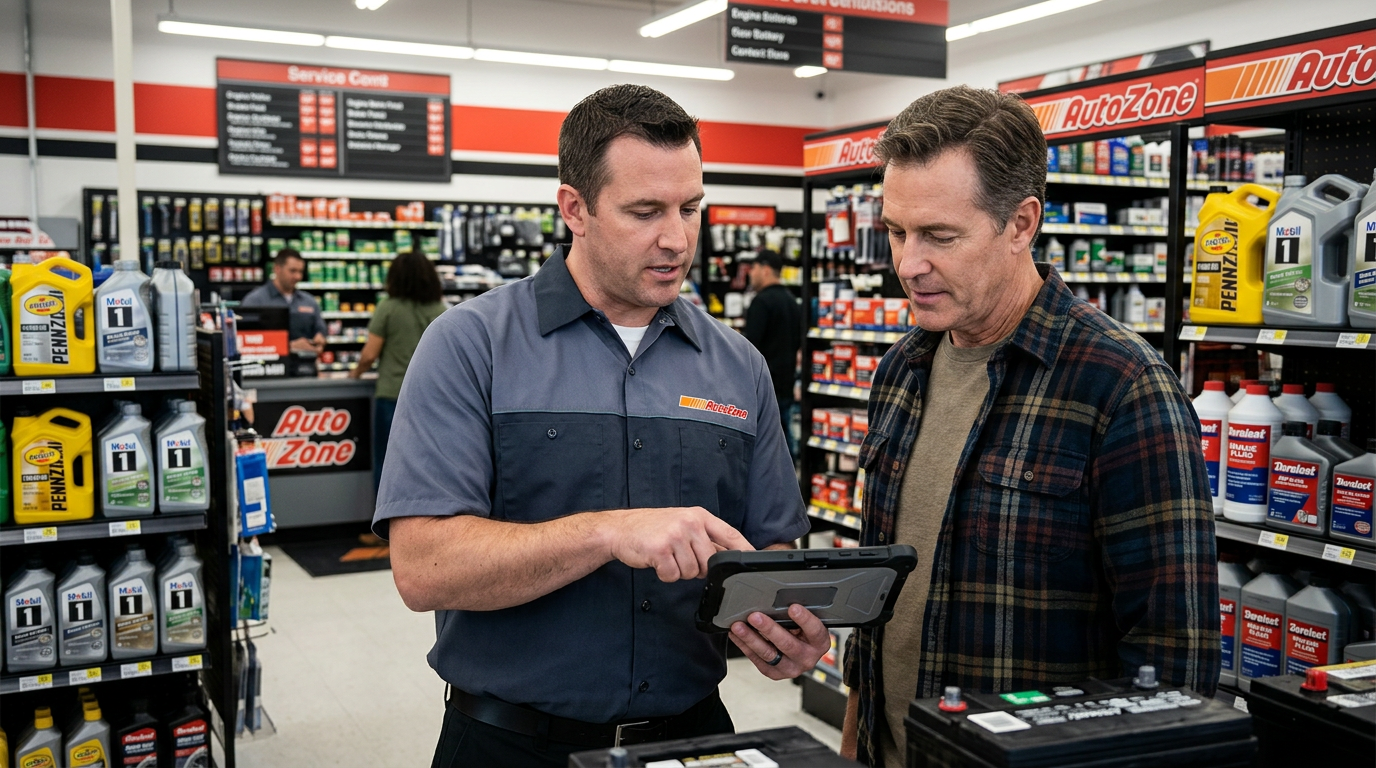
Here’s the thing about AutoZone right now. The stock is down roughly 8% year to date, recently trading around $3,100. The Wall Street consensus target is $3,969. That’s a ~28% gap — and 27 analysts are on record with a consensus rating of Strong Buy. So either the market knows something they don’t, or this is exactly the kind of dislocation that gets interesting.
It started with Q3 fiscal 2026, reported May 26. The quarter was, by most measures, the strongest in three years.
The numbers:
- Net sales of $4.84 billion, up 8.4% year over year
- Domestic same-store sales up 4.1%; total company comps up 3.9%
- Diluted EPS of $38.07, beating the ~$36.2 consensus estimate by more than 5%
- Commercial sales up 10.4% to $1.4 billion
- 82 new stores opened globally in the quarter
- Adjusted after-tax ROIC of 36.3%
And yet — the stock fell sharply on earnings day. The reason? Revenue came in at $4.84 billion against a $4.86 billion estimate — roughly a $20 million shortfall on a $4.84 billion quarter (about a 0.4% miss).
The business itself barely flinched. The market’s reaction was different.
Why the Long View Is Harder to Dismiss
The bull case on AutoZone isn’t complicated. It’s just boring enough that people keep underestimating it.
In early 2026, the average age of a light vehicle on American roads hit a record 13.0 years. That matters because the most profitable window for parts retailers — when major components start failing but the car is still worth fixing — is roughly years 6 through 14. The peak sales years of 2014 through 2019 have moved squarely into that window. That’s not a temporary tailwind. That’s a demand floor that doesn’t disappear next quarter.
Slight tangent, but it matters: Advance Auto Parts has been shuttering stores and selling assets for two years. AutoZone has been capturing those displaced customers and taking share at exactly the right moment in the fleet aging cycle. The two things are compounding each other.
The commercial side is the piece people keep missing. Domestic commercial sales hit $1.4 billion in Q3, up 10.4%. That business serves professional repair shops and installers — recurring, sticky, volume-driven accounts that don’t respond to weather or consumer sentiment the same way DIY traffic does. Nearly $1 billion in year-to-date capex has been directed at new stores and Mega-Hub expansion, which management says are outperforming their original forecasts.
156 Mega-Hub stores. The target is 300 at full build-out. That network density is what gives AutoZone parts availability that independent shops can’t replicate. It’s not just a tailwind story. It’s an infrastructure moat.
The Capital Machine
On June 16, AutoZone’s board approved an additional $1.5 billion in share repurchase authorization, bringing cumulative buyback authorization since 1998 to $42.2 billion. In Q3 alone, the company repurchased 164,000 shares for $586.3 million.
This is the part of the model that separates AZO from most retailers. Operating discipline converts into per-share earnings growth even when top-line comps run at mid-single digits. Q4 fiscal 2026 reports September 29. That’s the next real inflection point.
Forward Scenarios
Bull: Domestic same-store sales hold above 4% in Q4, DIY traffic counts stabilize after running at -3.6% in Q3, and commercial momentum continues at 8%+. Re-rating toward 23-26x forward earnings brings the stock back toward the analyst consensus range.
Base: Commercial growth decelerates slightly, DIY traffic stays soft, and AZO grinds higher on buyback-driven EPS growth. Upside limited but downside protected by fundamental quality.
Bear: International weakness in Mexico and Brazil compounds LIFO accounting drag on gross margin. DIY traffic continues declining as consumer budgets tighten. Multiple compression keeps the stock range-bound through FY2027.
Technical Read
AZO sits near the low end of its 52-week range, which recently put the stock’s low around $2,928 and its high around $4,388. The stock has recovered partially from the post-earnings lows but remains well below its 200-day moving average. Until commercial comp data from Q4 provides a clean re-entry catalyst, the chart is a consolidation story, not a momentum story.
What to Watch
- Q4 FY2026 earnings: September 29, 2026
- Domestic same-store sales comp trend vs. commercial growth rate
- DIY traffic count recovery or continued softness
- LIFO inventory adjustment impact on gross margin
- International performance in Mexico and Brazil
The real debate isn’t whether AutoZone is a good business. It clearly is. The debate is whether the market has already priced in a prolonged softness that may not materialize — and whether a ~28% gap to consensus eventually gets resolved by the stock moving, or the targets coming down.
At around $3,100, the business hasn’t changed. The question is whether the price has overcorrected.
For informational purposes only.