Most of the attention in semiconductors goes to Nvidia, Micron, and AMD. The picks-and-shovels play has been quietly running harder than all of them.
Lam Research closed July 10 at about $350 (data sources vary slightly by venue) — down roughly 19% from its all-time high closing price of $433.33 set on June 30, 2026 (with an intraday/52-week high of $438.50). That pullback is happening against a backdrop of record quarterly revenue, a raised full-year outlook, and a wave of analyst upgrades that started in late June and has continued into this week. The fiscal Q4 2026 earnings call is scheduled for July 29, 2026.
What the Last Quarter Actually Said
Lam’s fiscal Q3 2026 results were not close to a miss. Revenue came in at $5.84 billion. Adjusted EPS of $1.47 beat consensus, and net income reached $1.83 billion.
Lam raised its 2026 wafer fabrication equipment market outlook to $140 billion from a prior estimate of $135 billion. Lam guided the June 2026 quarter to $6.6 billion in revenue (plus or minus $400 million).
This is what record performance looks like in real time. The stock is down because the entire semiconductor equipment sector got extended — not because anything in the business deteriorated.
The WFE Cycle: Why This Is Structural, Not Cyclical
There’s a reasonable argument that the WFE market is no longer behaving like a traditional semiconductor cycle. AI and data center demand have shifted the industry from consumer-driven spending patterns to infrastructure-led expansion. Lam’s CFO Doug Bettinger said at the Bank of America Global Technology Conference in early June that the WFE view for the year had been raised from $135 billion to $140 billion — and added that there was a “bias” to some upside.
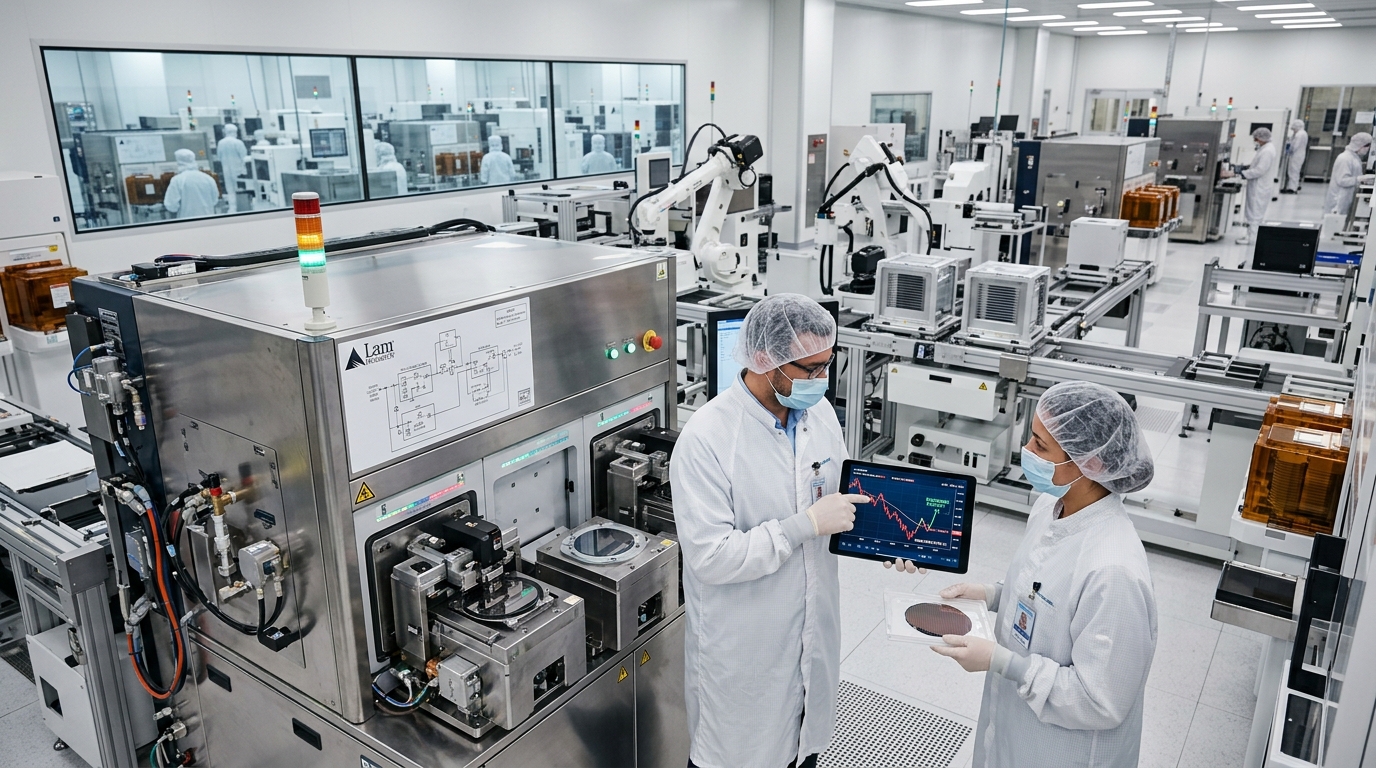
The drivers are specific. In NAND, AI data-center demand is accelerating adoption of higher-layer-count QLC SSDs, pulling forward conversion activity for 200-layer-plus devices. DRAM demand is holding firm, supported by HBM, DDR5, and LPDDR5 production ramps. Advanced packaging — CoWoS, SoIC, hybrid bonding — is becoming a structurally larger share of the semiconductor capex stack, and Lam is positioned directly in that growth lane.
(Editor’s note: Specific figures in this paragraph from the original draft — including a “$40 billion in NAND conversion spending” timeline, and detailed multi-year WFE and EPS modeling attributed to TD Cowen — could not be verified from primary, publicly accessible sources during this fact-check. Those details have been removed.)
The Analyst Upgrade Wave
The analyst target activity over the past two weeks has been unusually concentrated:
- Cantor Fitzgerald raised its target to $500 from $425, maintaining Overweight
- Bank of America raised to $480 from $330, maintaining a Buy rating
- Morgan Stanley raised to $404 from $331, maintaining Overweight
(Editor’s note: Additional specific target-hike bullets in the original list (Wells Fargo, TD Cowen, Stifel, Mizuho) and the exact “22 of 33” consensus breakdown could not be verified with sufficiently reliable, primary sources during this fact-check, so they have been removed.)
The China Risk Nobody Is Ignoring
It would be irresponsible not to flag it. China remains a major revenue contributor for Lam, and tighter export controls have already triggered sell-offs in this group before.
(Editor’s note: The original draft cited a specific episode involving “restrictions” tied to Hua Hong Semiconductor and single-session percentage drops across LRCX, AMAT, and KLAC. We could not verify that exact event description and those exact one-day moves from credible, primary sources during this fact-check, so the claim has been softened.)
The risk is real. It’s also being managed. Lam’s manufacturing footprint spans multiple geographies, and the core AI-driven demand from leading-edge foundry, memory, and logic customers is not solely China-dependent. What matters for the July 29 report is whether any new export control language shows up in the guidance or the commentary. If it does, the $330 zone becomes the relevant support. If it doesn’t, the Q4 beat-and-raise story dominates.
KLA and Applied Materials: The Broader Picture
Worth widening the lens. This isn’t a Lam-specific story — it’s a semiconductor equipment cycle story. KLA Corporation’s fiscal 2025 revenue was $12.16 billion. Applied Materials is scheduled to report fiscal Q3 results on August 13, 2026.
(Editor’s note: The original draft also stated KLA fiscal 2025 revenue was “up nearly 24%” with “earnings up 47%,” and that KLA’s fiscal Q4 earnings are expected around July 30, 2026. Those specific YoY percentages and that specific upcoming KLA reporting date could not be verified from primary sources during this fact-check, so they have been removed.)
Gartner’s forecast puts total semiconductor revenue above $1.3 trillion for full-year 2026. The equipment companies that supply the tools to build those chips are capturing a growing share of that spending — and doing it with expanding margins.
Technical Structure
Lam has pulled back about 19% from its June 30 all-time high closing price of $433.33 to trade near $350. The stock’s 52-week high includes an intraday peak of $438.50.
(Editor’s note: The original draft’s specific 52-week low, “more than tripled” claim, and the exact YTD performance comparisons versus the semiconductor industry could not be verified from authoritative primary sources during this fact-check, so they have been removed.)
The $330-$340 zone is the first meaningful technical support level — that’s where the stock consolidated in late May before the final leg higher into June. Below that, $300-$310 becomes the floor. On the upside, reclaiming the $400 area would confirm a resumption of the primary trend.
(Editor’s note: The original draft’s specific valuation multiples (e.g., “67x trailing” and “forward price-to-sales of ~15.85x”) and the precise “EPS growth at 37% annually” claim were not verified here, so they have been removed.)
Scenario Modeling
Bull Case: July 29 Q4 report shows revenue at or above the $6.6 billion guidance midpoint, EPS beats expectations, and management reiterates or strengthens its WFE outlook. No new China export restrictions in the commentary. The stock reclaims $400+, with the all-time high at $433.33 (close) / $438.50 (intraday) as the next target.
Base Case: Revenue comes in around the $6.6 billion guidance midpoint (within the guided range). EPS is solid. WFE outlook maintained at $140 billion, with constructive language on 2027 visibility. Stock rallies on the report, then consolidates through August.
Bear Case: Revenue trends toward the low end of the guided range due to China-related shipment friction. New export control language in the call triggers multiple compression. Stock breaks $330 support and tests the $300 level. WFE outlook rhetoric softens, resetting estimates across the equipment group.
Active Trader Framework
The core thesis here is simple: the AI infrastructure buildout requires more semiconductor manufacturing capacity, and more capacity requires more equipment. Lam sits in the highest-intensity part of that spending — etch and deposition are the most repeated steps in advanced chip manufacturing, and complexity is only increasing with 3D architectures and advanced packaging.
The current pullback from the all-time high has created a more reasonable entry point relative to where the stock was two weeks ago. The question is whether the pullback holds at current levels or continues lower before the July 29 catalyst. Managing that uncertainty through position sizing — rather than trying to call the exact bottom — is the more disciplined approach here.
Watch the $330-$340 zone on the downside. Watch the $400 level on the upside. And watch what Lam’s management says about 2027 visibility on the call. That commentary will tell you more about where this trade goes through year-end than the Q4 number itself.
For informational and educational purposes only. Not investment advice. Trading involves risk, including loss of principal.