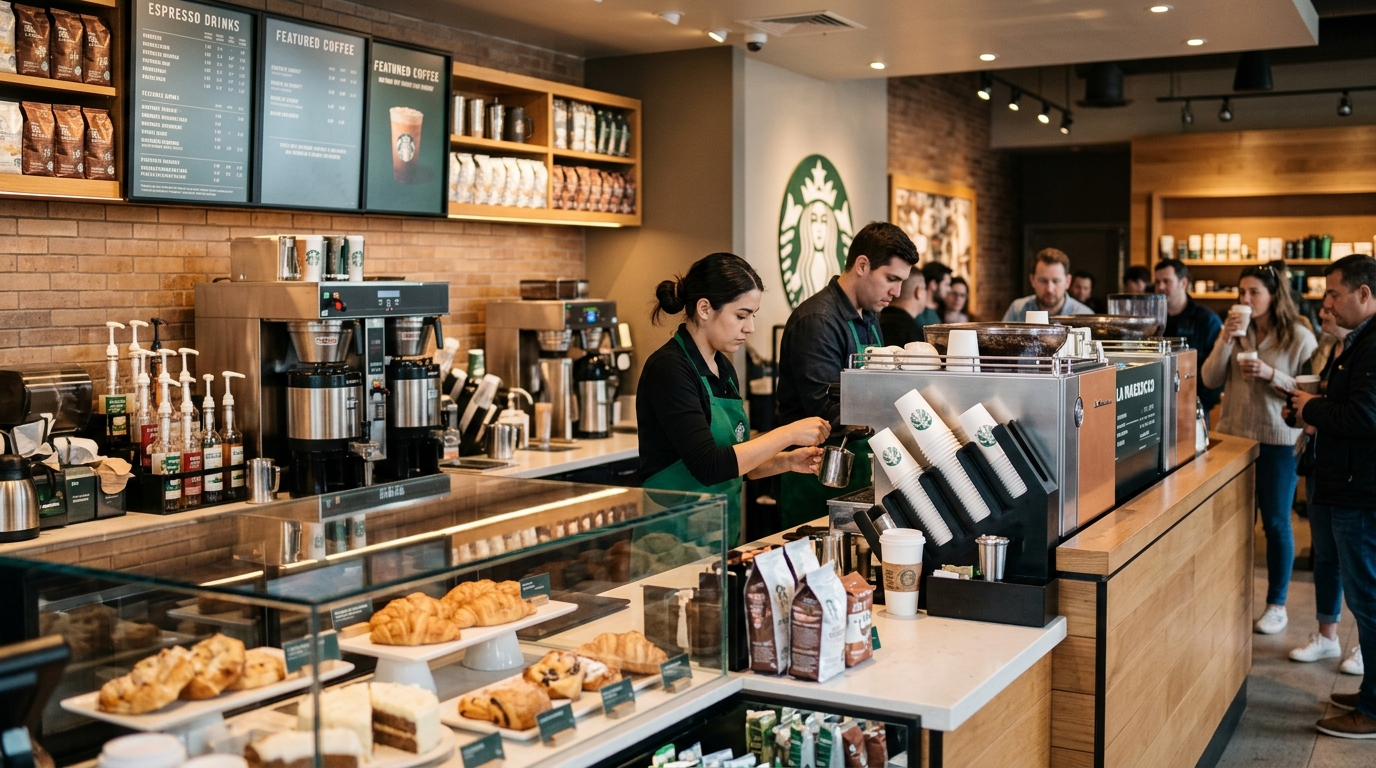
The turnaround story is working. That is actually the problem.
Starbucks trades at roughly 45x forward earnings right now. That multiple does not get assigned to a company in recovery. It gets assigned to a company where the recovery is already assumed to be complete, permanent, and expanding for years. So when the fiscal third-quarter results land after the close on July 29, the math is simple: the numbers either justify the valuation, or they don’t.
And given how the last four quarters have gone, there is genuine room for debate here.
What the Street Is Expecting
Starbucks plans to release its third quarter fiscal year 2026 financial results after market close on Wednesday, July 29, 2026. The coffee chain is expected to post quarterly earnings of $0.66 per share. Revenues for the quarter are expected to be $9.44 billion.
So the expectation is strong earnings growth on essentially flat revenue. That means the entire bull case for this quarter lives or dies on margin expansion. Traffic and comparable-store sales have to do the work, and the cost savings from the “Back to Starbucks” restructuring have to actually show up in the income statement.
Starbucks’ recent earnings history has been uneven versus estimates. That track record matters. It’s the reason this earnings date is tenser than it looks on the surface.
What Has Actually Been Working
To be fair, the fundamental momentum is real. Global comparable store sales increased 6.2% in Q2 fiscal 2026.
Early results show positive momentum, particularly in North America, where comparable store sales increased 7.1%. That is the number Brian Niccol pointed to as evidence the strategy is working. First U.S. transaction growth in two years. Loyalty membership at a record. The operational discipline that made him famous at Chipotle is starting to show up in the traffic data.
90-day active Starbucks Rewards membership reached a record 35.6 million, up roughly 4% year-over-year. That is the kind of engagement metric that leads revenue, not follows it. The loyalty flywheel is moving.
And there is the AI angle most people are sleeping on. Starbucks is developing in-house tools with the help of AI that could replace some software applications it currently buys (including tools from Microsoft and IBM). The company has said it spends about $400 million a year on software and is pursuing a broader $2 billion cost-reduction effort; an internal presentation cited the enterprise technology team being on track to reduce its budget by about $30 million in the fiscal year ending in late September. That is a margin lever that does not require selling a single extra cup of coffee.
The Valuation Problem
Here is where I keep getting stuck. At about $105, Starbucks trades at a P/E ratio of about 45 based on the midpoint of this year’s adjusted earnings-per-share guidance. A multiple like that assumes the traffic recovery continues and margins climb well beyond this year’s guided levels for years to come.
Q2 fiscal 2026 showed an operating margin of 9.9%. So the stock is pricing in a return to near-peak margins while the current operating margin is barely half of the roughly 18% operating margin Starbucks reported in Q2 fiscal 2024. That is a lot of future to be paying for today.
Consumer spending remains pressured by economic uncertainty, with lower-income customers trading down or visiting less frequently. That is a real headwind. Starbucks is threading a needle: positioning a $9 coffee as an affordable luxury in an environment where the lower half of the income distribution is stretched. Niccol’s bet is that it works. The data so far supports the bet. But it is still a bet.
Options Analysis
IV is elevated heading into July 29, reflecting the binary nature of a high-multiple turnaround story at a critical inflection point. The stock moved sharply after Q2 results. The options market is pricing in a similar potential move this time.
- Bull case: U.S. comparable sales hold above 5%, operating margin expands meaningfully quarter-over-quarter, and management raises or reaffirms guidance. A defined-risk call spread targeting a move toward $115-$120 captures the scenario where the market concludes the turnaround is accelerating on schedule.
- Bear case: Comp growth decelerates from Q2’s 6.2% pace, margins disappoint relative to expectations, or management signals caution on the second half. At 45x forward earnings, any guidance softness hits harder than it would for a cheaper stock. A put spread targeting a reversion toward $90-$95 defines the downside clearly.
- Neutral case: Results come in roughly in line, guidance holds, and the stock moves within a tight range. A short straddle or iron condor captures the IV crush that typically follows a clean in-line quarter.
The items worth watching are U.S. comparable sales and transactions holding anywhere near the fiscal second quarter’s pace, operating margin continuing to expand, and any change to the full-year outlook.
Analyst-consensus figures (ratings, target prices, and analyst counts) vary by data provider and update frequently; treat any single snapshot with caution. That narrow consensus upside is worth sitting with for a moment. The analysts who cover this stock most closely are calling for essentially no appreciation from here over the next year. They like the company. They just think the price already reflects it.
The market has priced in Niccol’s Chipotle magic before the Chipotle results have fully shown up. July 29 is when the evidence either starts catching up to the expectation, or the gap gets harder to ignore.