
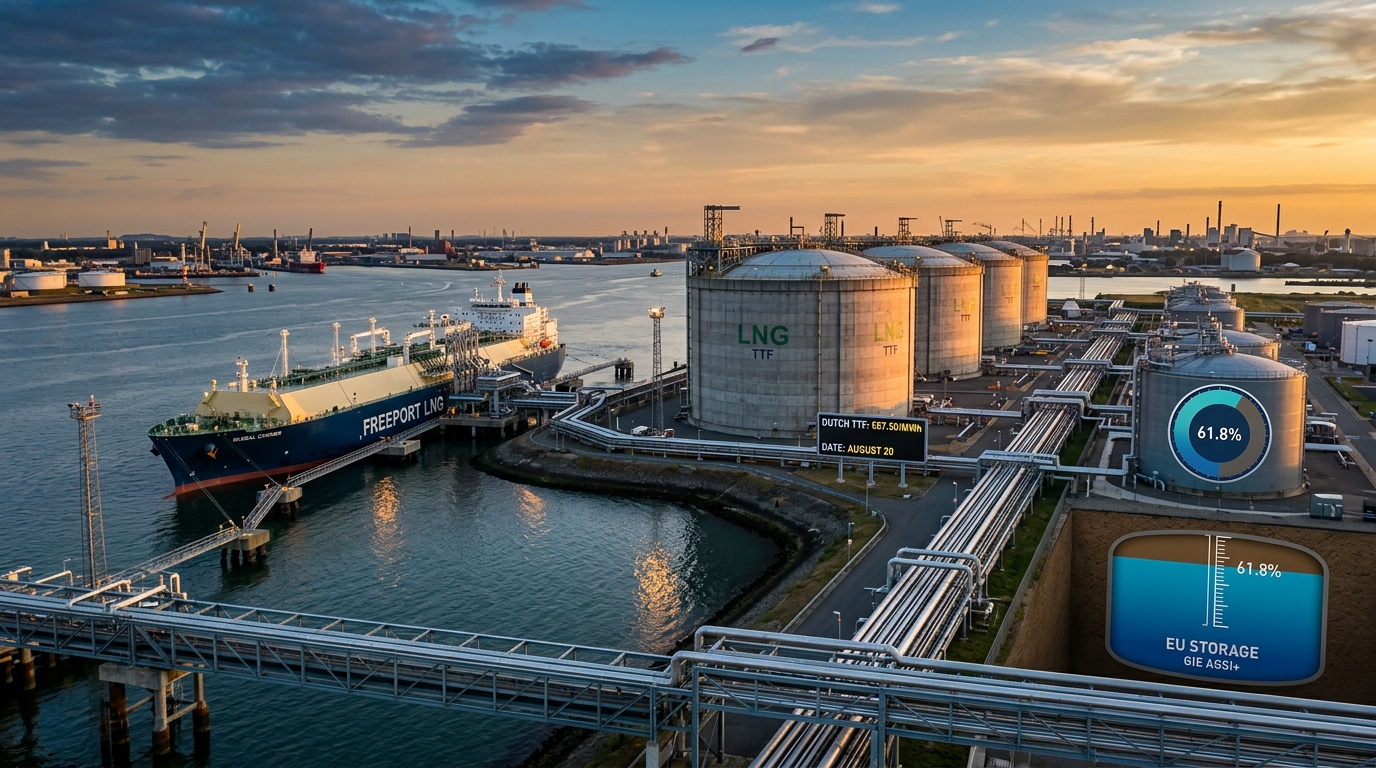
The injection window in Europe closes in roughly five weeks. Dutch TTF futures are trading near €66-69/MWh this week, against a 52-week low near €26.5/MWh, a move that has more than doubled the benchmark since January. EU storage sat at about 61.8% of capacity as of August 20, according to Gas Infrastructure Europe’s AGSI+ platform, running roughly 9 to 10 percentage points below the five-year seasonal norm. The European Gas Hub published analysis on August 19 projecting that current injection trends put November 1 fill near 70%, well short of the 80% benchmark policymakers have emphasized for this winter.
On the US side, Henry Hub is a different world. The EIA’s August Short-Term Energy Outlook cut its Q3 2026 Henry Hub forecast to $2.87 per MMBtu from $3.37 in the prior month’s STEO, citing record domestic production and softened LNG feedgas demand during Freeport’s maintenance outage. That outage began July 10 and knocked feedgas deliveries down with the plant running well below normal. Freeport has said the turnaround is expected to be completed in late August. When Freeport restarts, feedgas demand snaps back and the domestic price floor moves with it.
The spread between TTF and Henry Hub, after accounting for liquefaction and shipping costs of roughly $3-4/MMBtu, still leaves a clear arbitrage window. September TTF-to-Henry Hub spread pricing still implies a meaningful premium for Europe. Every cargo Freeport could not send during maintenance is a cargo Europe did not receive. That shortfall matters most between now and late September, when the injection season ends.
Regulation (EU) 2026/261, adopted January 26, 2026, sets a stepwise phase-out of Russian gas, with a full ban on Russian LNG imports taking effect from the beginning of 2027 and pipeline gas phased out later. Russian volumes continued to flow in H1 2026, reportedly up year-on-year, while US volumes grew more modestly. That Russian flow ends in a little over four months. Hormuz disruptions have kept Qatari spot supply constrained since March. The structural gap between what the EU must replace and what the US can realistically deliver is the core thesis, and the market has not fully priced the post-January supply reset.
Where to Position
Among pure-play exporters, Cheniere Energy (LNG) raised its 2026 EBITDA and cash flow guidance and trades near $268, below its March high near $295. Corpus Christi Stage 3 is in the late innings, with Train 5 reaching substantial completion on March 27. CQP, Cheniere’s MLP, adds yield alongside that volume ramp at roughly $68 with a $0.82 quarterly distribution. Venture Global (VG) near $13 carries more leverage to spot-market pricing given a larger uncontracted book, but ongoing litigation deserves scrutiny before sizing a position.
On the midstream side, Kinder Morgan (KMI) transports approximately 40% of the natural gas produced in the United States. It has climbed 27% year to date after beating Q2 estimates and raising guidance. Williams Companies (WMB), up 33% year to date near $73, carries a richer multiple but its Transco system is directly exposed to Gulf Coast feedgas flows. Energy Transfer (ET) provides a lower-multiple entry into the same theme near $21.
Risk Dashboard
The thesis weakens on two signals: a confirmed Hormuz reopening that restores Qatari supply, or a warm European autumn that cuts withdrawal pressure heading into winter. It strengthens if EU storage misses the 80% benchmark. Some analytics services estimate that each 5-point storage shortfall can translate into multiple weeks of reduced supply buffer at peak winter demand rates, depending on weather and flow constraints. The September injection close is the catalyst. Position before it, not after.