Here is the real question from Thursday’s Gap Inc. earnings report: what happens to a turnaround story when the brand doing the turning around is not the one that matters most to the revenue line?
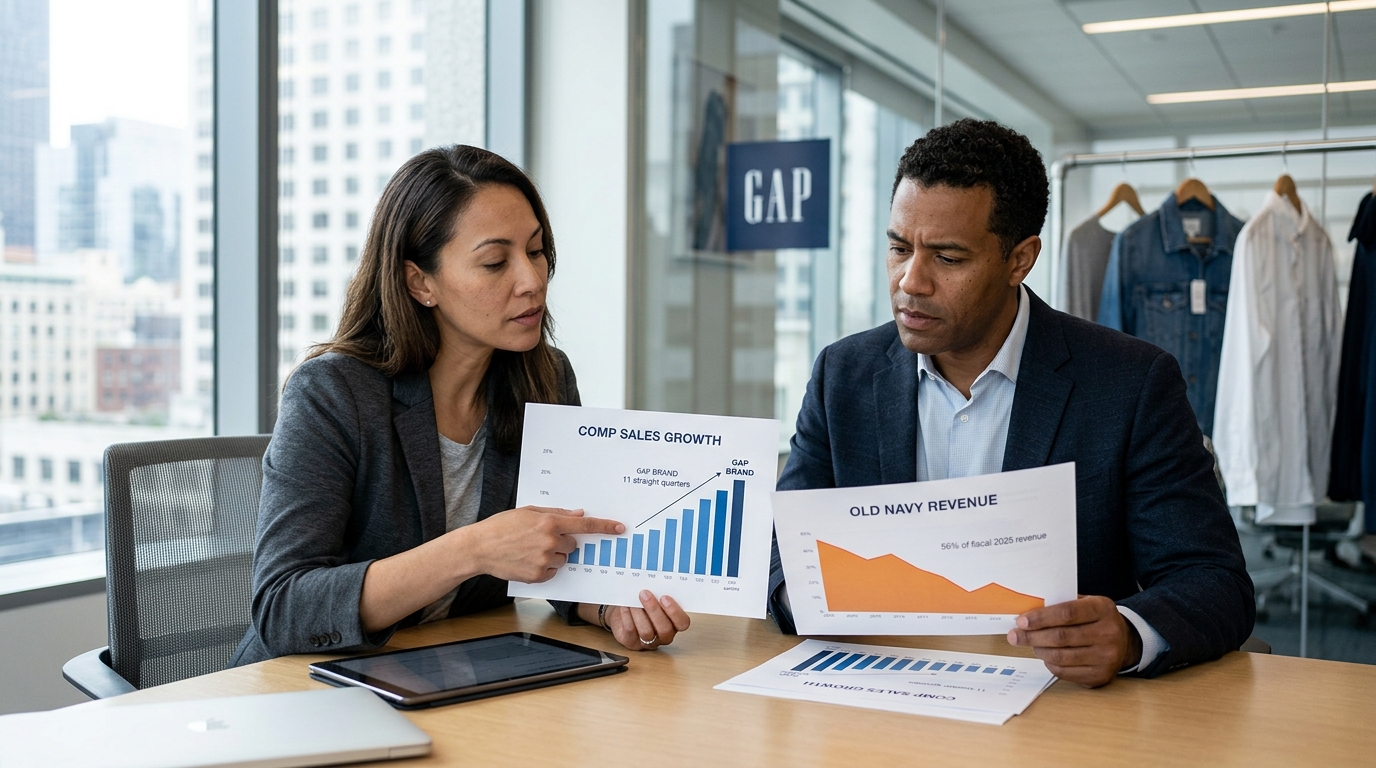
At the namesake Gap brand, CEO Richard Dickson said the company is “firing on all cylinders,” with 11 consecutive quarters of positive comps, including another double-digit result in fiscal Q2. Gap brand net sales rose 9% to $844 million, with comps surging 10%. That is a genuine turnaround, not a marketing refresh. Dickson cited broad-based improvement across traffic, units, and average unit retail, spanning men’s, women’s, and kids and baby.
Then there is Old Navy, which generates more than half the company’s total revenue. Old Navy’s net sales fell about 4% to $2.1 billion in the quarter. “Ultimately, our slight miss on total company was really due to Old Navy’s seasonal product assortment,” Dickson told analysts. That is two straight quarters of fashion misses at the portfolio’s anchor brand, following a Q1 where Old Navy’s 1% comp came in well below the 3% Wall Street had expected.
The profit numbers looked far better on the surface. Adjusted earnings per share came in at 52 cents, beating the 48-cent consensus estimate, while revenue of $3.65 billion narrowly missed the $3.69 billion expectation. Reported gross margin of 52.8% increased 1,160 basis points versus last year, largely because of the net IEEPA tariff recovery recorded in the quarter. Investors need to look past that headline figure. Adjusted gross margin, excluding the tariff recovery and related interest income, was 41.4%, up just 20 basis points year-over-year. The underlying business improved modestly. The reported margin line moved dramatically because of a one-time accounting adjustment, not a structural shift in how Gap buys or prices merchandise.
In Q2, the company recorded a $417 million adjustment to cost of goods sold related to the net IEEPA tariff recovery. Gap received $95 million in cash refunds in Q2, plus $5 million of related interest income, with the remaining refunds and related interest income expected in Q3. That cash is real, but it is also backward-looking. Going forward, the adjusted gross margin of 41.4% improved only 20 basis points year-over-year, while adjusted operating margin of 7.1% actually declined 70 basis points as operating expenses rose to 34.3% of sales.
Gap raised full-year adjusted EPS guidance to $2.35 to $2.45, above the prior range of $2.30 to $2.40. The updated full-year sales outlook of 1% to 1.5% growth now assumes Old Navy comparable sales of flat to down 1%, compared with the prior assumption of flat to up 1%. The guidance raise is real. The revenue cut at Old Navy is also real, and the two are moving in opposite directions.
Which brings us to the leadership change. Gap named Michael Francis as President and CEO of Old Navy, effective November 2, 2026. Francis is best known for his long career at Target, including serving as an executive vice president and chief marketing officer. He joined Gap Inc. in March 2026 as Chief Customer Officer of Old Navy and Head of Marketing Shared Services. The appointment signals that Gap’s primary diagnosis for Old Navy is a brand and marketing problem, not an operational or cost one. That framing has merit given where the misses have appeared: seasonal fashion categories, not core denim or active.
The risk is timing. Francis does not take the reins until November 2, meaning he will have little influence over the holiday assortment already being set. Gap brand comps are now expected to grow in the high-single to low double-digit range for the full year, above prior expectations, while Old Navy expectations have been cut. The portfolio is pulling in opposite directions, and the smaller brand is winning while the larger one stumbles into the most important selling season of the year.
Investors bidding shares up roughly 15% Friday morning are pricing in a clean resolution: tariff cash in hand, profit guidance raised, a credible operator arriving to fix Old Navy, and Gap brand momentum continuing. Each of those things is plausible. What the market may be underweighting is the sequencing problem. Old Navy accounts for the bulk of Gap Inc.’s revenue, its holiday trajectory is already baked in without Francis, and the adjusted margin improvement that actually reflects business quality is a narrow 20 basis points. The bull case works if Francis accelerates Old Navy’s recovery by spring 2027. The bear case is simpler: if Old Navy stumbles again in Q3, the Gap brand’s 11-quarter streak is no longer enough to cover the gap.