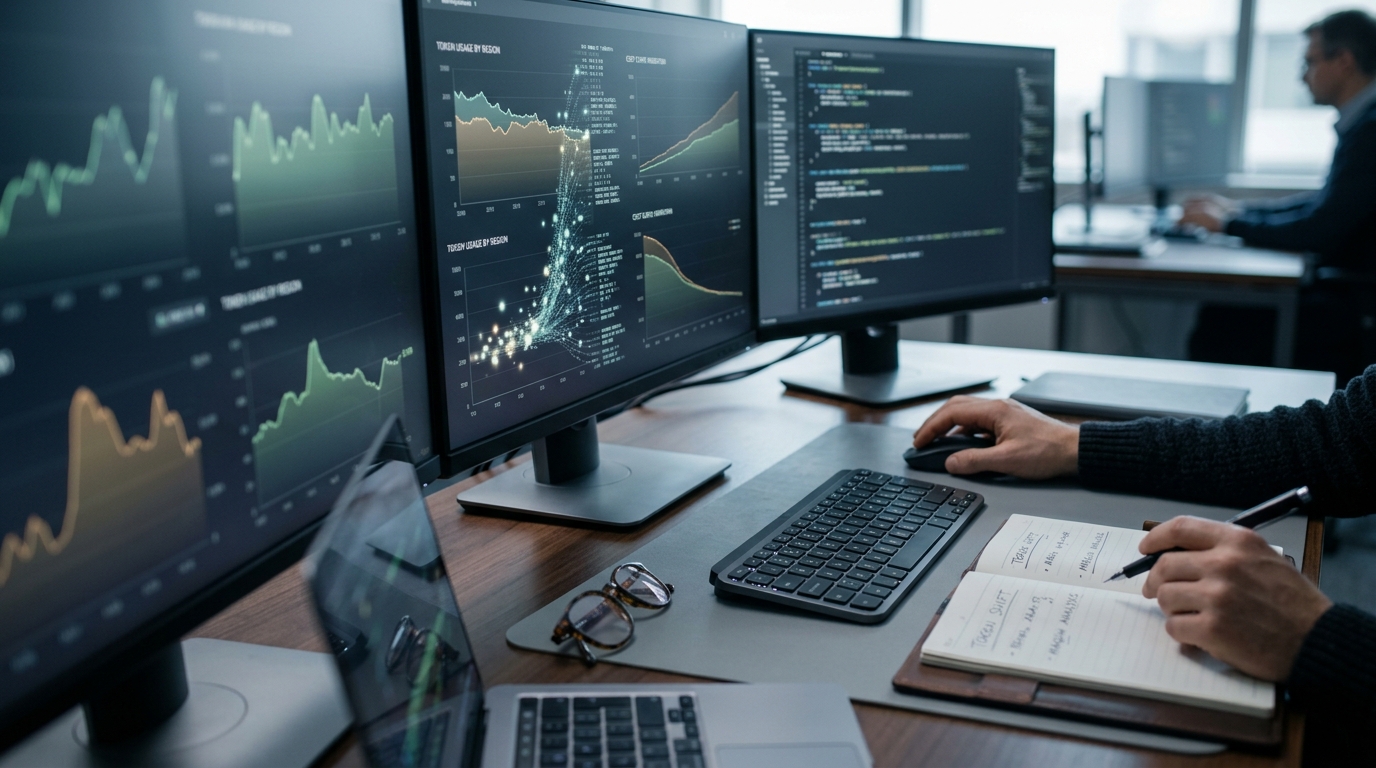
The number that should occupy every AI investment committee this week is not a quarterly revenue beat. It is a usage figure from a developer routing platform. On OpenRouter, Chinese models accounted for 57% to 67% of tokens used in the week of September 14, up from 6% to 13% in February. On Vercel, open-weight models’ share rose to 56% of tokens in August from about 7% in December 2025. That is a measured shift in real production traffic, not a vibe. It is also the most precise test available for whether AI spending is about to peak, flatten, or bifurcate.
Why Wall Street Cares
The bull case for American AI names has always rested on a simple assumption: superior capability commands premium pricing, and usage follows capability. The OpenRouter data challenges that assumption directly. “Price is doing the work here,” Harpreet Arora, head of agentic infrastructure at Vercel, told CNBC. “When a task doesn’t need the best model, teams are beginning to route it to the cheapest one that’s good enough, and the recent wave of models coming out of China is winning that trade.” That routing logic, applied at scale, is a structural threat to inference margin at OpenAI and Anthropic, and a secondary threat to Microsoft and Google as the clouds that host them.
The Bull Case
Token volume on routing platforms is not revenue. Lower prices and strong performance are helping drive adoption for coding and other agentic tasks, although U.S. frontier models still attract more overall spending. Google reported that Google Cloud revenues accelerated to 82% growth in the quarter ended June 30, 2026, driven by demand for AI infrastructure and AI solutions. The argument from bulls is that OpenRouter represents the price-sensitive tail of the market: startups and hobby projects. Enterprise customers building regulated, sensitive, or complex workflows still pay for frontier models, and that is where the money lives.
There is also a chipmaker angle. Nvidia reported revenue of $96.2 billion in the quarter ended July 26, 2026, up 106% from a year ago. Chinese open-weight inference still runs on hardware. Every token, cheap or expensive, is a compute event.
The Bear Case
The pricing gap is large enough to change corporate behavior permanently. Open-weight Chinese models are consistently far cheaper than leading offerings from Anthropic and OpenAI. As of late September 2026, DeepSeek V4.1 Flash is priced at $0.14 per million input tokens (cache miss) on DeepSeek’s rate card, while OpenAI’s GPT-5.5 is priced at $5.00 per million input tokens. For a similar workload, Anthropic’s Claude ran $4,811, OpenAI $3,357, and Zhipu’s GLM $544, based on a widely circulated enterprise comparison. At those differentials, even enterprise finance teams take notice. Among developers building with open-source tools, 80% use Chinese open-source tools, according to a16z research.
The shift is drawing scrutiny in Washington, where lawmakers are investigating the growing use of Chinese AI amid concerns about technology competition, security, and Beijing’s global influence. The House Committee on Homeland Security and the House Select Committee on China are conducting a joint investigation into the adoption. That scrutiny could produce restrictions, but it could equally confirm that the penetration is already deep enough to be difficult to reverse.
What Investors Are Missing
The more interesting threat is not to inference revenue today but to the hardware cycle that everyone is pricing in for 2027 and beyond. Alibaba used its September 22 developer conference to show how quickly China’s AI stack is filling the holes left by restricted access to U.S. chips, unveiling the Zhenwu V900 accelerator, which it says delivers roughly three times the performance of its predecessor and is scheduled for mass production and commercial release in the first quarter of 2027. Nvidia’s latest 10-Q says shipments of data center Hopper products to China were under 1% of its $89.0 billion in data center revenue for the quarter ended July 26, 2026. The China hardware gap is already priced out of Nvidia’s numbers. What is not fully priced is the scenario where domestic Chinese silicon grows capable enough to serve Chinese model inference globally, routing demand away from the U.S. hyperscale buildout entirely.
The competition could evolve into a two-track market: the most advanced models competing on capabilities while lower-cost and open-weight models compete aggressively on accessibility and price. That is the scenario where Google and Microsoft retain enterprise margin but lose the volume base that justifies current infrastructure capital expenditure.
Stocks to Watch
Microsoft (MSFT) holds the most direct exposure. Its AI revenue is structurally tied to OpenAI inference running through Azure. If enterprise customers begin routing a larger share of workloads to self-hosted Chinese models, Azure consumption growth slows before the capital investment does.
Nvidia (NVDA) is the apparent paradox. Chinese token growth runs on someone’s chips, and for now a large part of that is still Nvidia’s installed base globally. The risk is on a 12-to-24-month horizon, as Alibaba’s V900 moves toward volume production.
Alphabet (GOOGL) is the most defensible American name in this debate. Google said it lowered Gemini serving unit costs by 78% over 2025, giving it a cost structure closer to Chinese competitors than OpenAI has. Its TPU infrastructure is a genuine moat on inference economics.
Alibaba (BABA) is the Chinese name with the clearest investment case. It sits at the intersection of model development, proprietary silicon, and cloud distribution. Its next-generation Zhenwu V900 is targeted for mass production in early 2027.
OpenAI faces the sharpest structural question of any company in this discussion. Public reporting around OpenAI’s unit economics is contested, and the company does not publish full financial statements. What is clear is that if token volume migrates to cheaper Chinese alternatives, the revenue needed to cover a high fixed-cost inference footprint does not follow automatically. The cost curve, not the capability curve, is what developers are currently voting with.