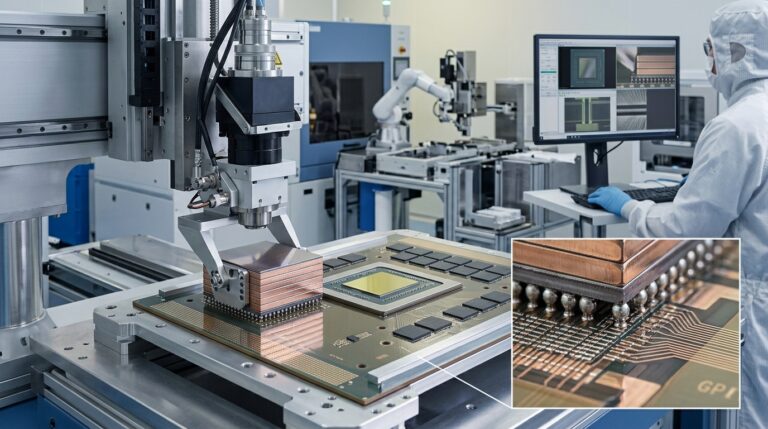
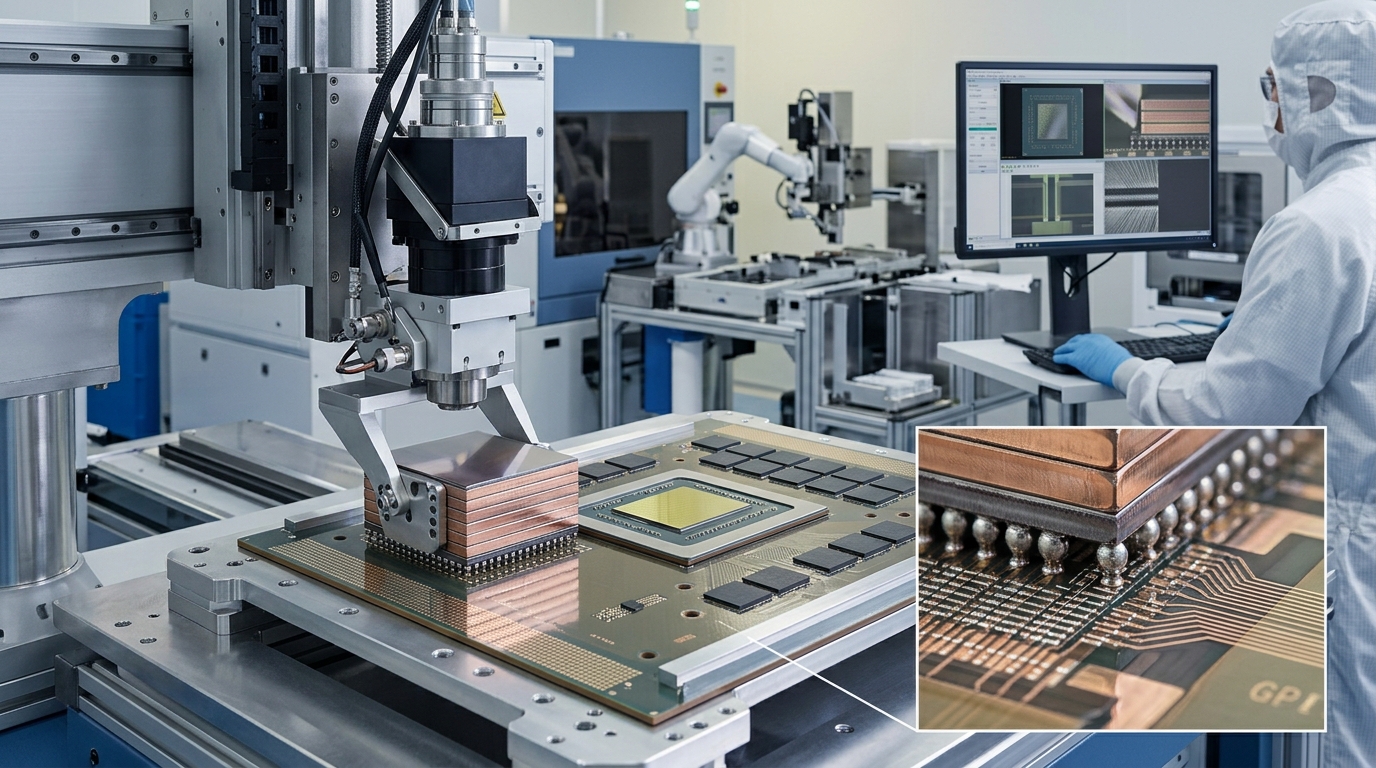
Most investors tracking the AI infrastructure buildout focus on GPU die yields and Nvidia’s fab allocations at TSMC’s leading-edge logic nodes. That framing misses where the supply chain actually breaks. The binding constraint on next-generation AI server shipments is not silicon. It is the advanced packaging step that joins the memory and compute die together. Fix that bottleneck and every other discussion about AI server lead times changes. Leave it unsolved and the capacity expansion story remains largely theoretical.
The architecture involved is called CoWoS, short for Chip-on-Wafer-on-Substrate. It is TSMC’s 2.5D packaging process that mounts the GPU die and its HBM stacks side by side on a shared silicon interposer. That interposer step is not standard back-end assembly. The silicon interposer fabrication requires front-end cleanroom standards, which means expanding capacity competes for overlapping capital equipment used in logic fabrication. CoWoS expansion requires advanced lithography and deposition tools, with long lead times. You cannot accelerate around that queue.
The numbers are stark. Estimates for TSMC CoWoS capacity by late 2026 vary widely by source, but many cluster around roughly 90,000 to 140,000 wafers per month by Q4 2026, up materially from end-2025 levels, yet packaging remains the binding constraint on AI accelerator output. Capacity growth still leaves lines heavily booked because demand is rising alongside it. CoWoS capacity has been widely described as sold out into 2026 and beyond. Packaging, not wafer starts, gates AI accelerator shipments. For a company trying to deploy Nvidia Blackwell or the newer Vera Rubin platform before 2027, those lead times are not a footnote. They are the delivery schedule.
Nvidia’s dominance of this chokepoint is striking on its own terms. Multiple analyst and industry reports have put Nvidia at roughly around 60% of TSMC’s CoWoS capacity. That concentration means every other CoWoS customer, AMD, Google, Amazon, Microsoft, is competing for the remainder. Claims that the four largest AI chip designers collectively consumed over 90% of global CoWoS capacity and HBM supply by value in 2025, but only about 12% of global advanced logic die production, are not consistently supported by public, independently verifiable data, and should be treated as directional rather than precise. The packaging ecosystem is far more concentrated than the wafer ecosystem.
Memory sits on top of that constraint, not beneath it. The reason accelerator lead times stay long is often not the logic die. It is the memory sitting next to it, and the packaging line that has to join the two. Nvidia’s Blackwell B200 GPU is widely specified with 192 GB of HBM3E versus 80 GB on the H100, which means each successive GPU generation can consume disproportionately more of an already-constrained memory supply. Micron has said its HBM output is sold out for calendar 2025 and has signaled strong demand discussions for 2026, and industry reporting has repeatedly described 2026 HBM supply as effectively fully committed across suppliers. SK hynix previously reported HBM3E yields approaching 80%, and Samsung faced well-reported delays getting 12-layer HBM3E qualified for Nvidia earlier in the cycle. That yield and qualification gap matters because it concentrates effective supply even further inside one vendor.
The second-order implication for investors is that the CoWoS capacity expansion at TSMC, and the HBM4 ramp at the major memory suppliers, are themselves constrained by the equipment manufacturers feeding into both. Applied Materials, ASML, and the thermal management materials vendors sitting upstream of those fabs carry the earliest signal on whether packaging relief arrives in 2027 or slips further. SK hynix has said demand for high-bandwidth memory is expected to outpace supply for several years, which is a multi-year revenue visibility statement dressed as a warning. Watch equipment order backlogs at both companies. That is where the actual timeline lives, before it shows up in any AI server delivery schedule.