
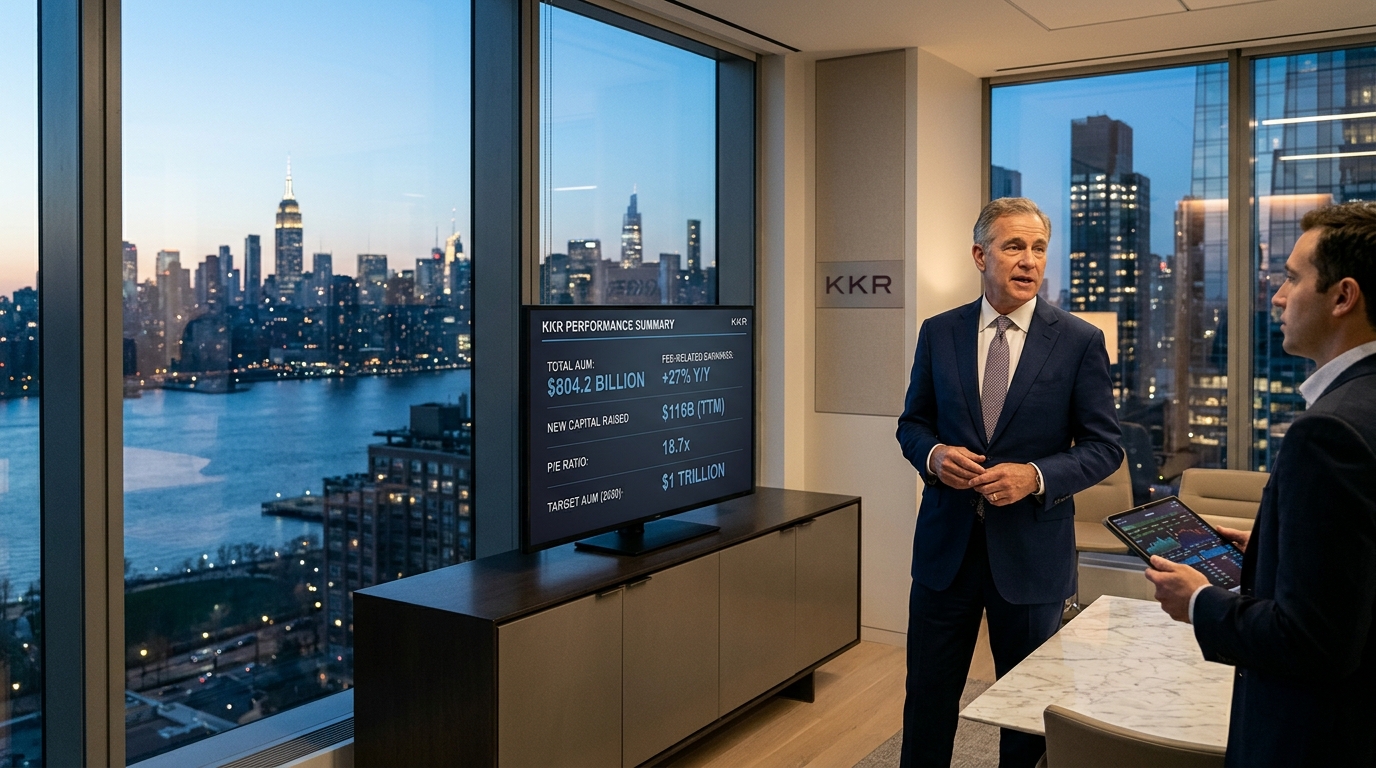
Most asset managers struggle when rates rise. KKR is different. The firm just reported its second consecutive record quarter on every headline metric, raised $116 billion in new capital over the past year, and is now telling investors it expects to reach $1 trillion in assets under management by 2030. The stock trades below 19 times earnings. That gap is worth examining.
The Business
KKR manages money across private equity, real assets, credit, and insurance. The firm earns fees whether its investments go up or down, which is what makes the fee-related earnings line the right number to watch. KKR reported third-quarter 2026 adjusted net income of $1.645 billion, an increase of 29% year over year, while assets under management reached roughly $804 billion. The firm achieved record quarterly fee-related earnings, total operating earnings, and adjusted net income per share.
Fee-related earnings increased 27% to about $1.316 billion during the quarter, equivalent to $1.42 per adjusted share. Over the trailing 12 months, fee-related earnings reached about $4.5 billion, an increase of 26%. The FRE margin hit around 71%, the highest in the firm’s history.
Why Wall Street Is Paying Attention
Three straight quarters of EPS beats, a rising margin profile, and an AUM base that keeps compounding. KKR raised $25 billion during the third quarter and $116 billion over the past year, bringing its assets under management to over $800 billion. It plans to reach $1 trillion in assets by 2030.
The perpetual capital figure is what institutional buyers focus on most. Total assets under management reached about $804 billion and fee-paying assets expanded to $648 billion. Perpetual capital reached $344 billion, representing 43% of total AUM and 50% of fee-paying AUM, providing a stable earnings foundation. Perpetual capital does not redeem. It compounds fees indefinitely. That is a qualitatively different business than a traditional private equity fund with a 10-year life.
Institutional accumulation is also consistent, though specific share-count changes vary by reporting period. Broadly, institutional investors and hedge funds own a substantial majority of the company’s stock.
What’s Driving the Opportunity
Rising rates, which have pressured every yield-sensitive sector since late October, are actually increasing the addressable market for credit-focused alternative managers. Borrowers who cannot access cheap bank debt turn to private credit. That is KKR’s sweet spot. KKR has about $75 billion of AUM not yet paying management fees, providing visibility for future management fee growth. That is deferred revenue waiting to convert as capital is deployed.
Analyst sentiment is constructive, with 18 Buy ratings and four Hold ratings, and an average price target of $122.95. Valuation screens vary by data provider and by whether the metric is based on GAAP earnings, adjusted earnings, trailing results, or forward estimates, but some services do show a sub-19 P/E at current prices. A PEG below 1.0 on a business growing fee-related earnings in the mid-20% range is the kind of combination that tends to attract long-only funds looking for quality at a discount.
What Could Go Wrong
Performance income is lumpy. KKR’s headline revenue beat in Q3 was partly distorted by how the firm books realized gains, which can swing widely quarter to quarter. Adjusted net income per share was $1.78 against a $1.59 estimate, while revenue of $4.56 billion compared with $2.69 billion expected, though the revenue comparison is distorted by how the firm books performance income. A dealmaking slowdown would also reduce realizations and pressure carried interest over time.
The December Fed hike is real pressure. After the October CPI report, CME FedWatch showed markets heavily pricing in a hike at the December 8-9 meeting, but not at 100%. Sustained higher rates compress private equity valuations and slow exit activity. KKR has managed this environment better than peers, but it is not immune.
The Bottom Line
KKR is growing fee-related earnings at 27% per year with about a 71% FRE margin. The business is structurally positioned to benefit from an era of persistent high rates because private credit expands when bank lending tightens. The $75 billion in AUM not yet paying management fees provides multi-quarter earnings visibility that most companies cannot offer. With the $1 trillion AUM target on the clock for 2030, KKR is a compelling combination of quality, momentum, and reasonable valuation in the financial sector right now.