
Here’s where things stand. Meta Platforms closed June 17 at $567.58. The 52-week high is $796.25. That’s a 28%-plus drawdown on a company that just reported its fastest revenue growth since 2021 and still controls the most powerful digital advertising machine on earth.
The math doesn’t add up at first glance. Then you read the earnings transcript again.
In Q1 2026, Meta posted $56.31 billion in revenue, up 33% year over year, and EPS of $7.31 adjusted versus $6.79 estimated. The beat was clean. Revenue guidance was upbeat. Operating margin held at 41%. Daily active people across the family of apps reached 3.56 billion. Those are not the numbers of a broken company.
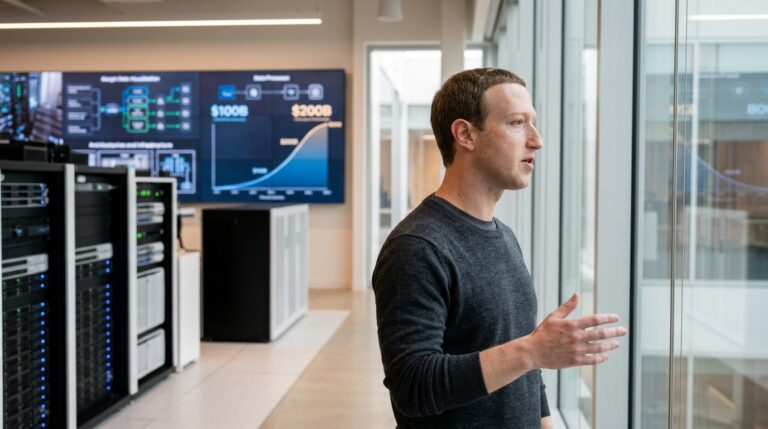
What spooked the market was the capex line. Meta raised its 2026 capital expenditure guidance to $125 billion–$145 billion. The company attributed the increase to higher component pricing and additional data center costs. Net income in Q1 climbed to about $26.77 billion, or $10.44 per share, from $16.6 billion a year earlier, though a significant chunk of that reflected an $8.03 billion one-time tax benefit tied to U.S. tax matters disclosed in the quarter.
The part people skip: Meta is the only hyperscaler in the Big Tech group that does not have a cloud business generating direct, measurable AI revenue. Alphabet showed 63% cloud revenue growth and investors rewarded it. Microsoft tied its spending to Azure momentum. Meta’s Zuckerberg said on the earnings call that the company does not yet have a very precise plan for how each individual AI product will scale. That sentence cost the stock.
Emarketer projects Meta will surpass Alphabet in total digital ad revenue in 2026, with $243.46 billion versus Alphabet’s $239.54 billion. That is not a struggling business. That is the most valuable advertising engine on the planet running at full speed while the market questions what comes after the ads.
The Structural Pressure Points
There are three things compounding the stock’s technical weakness right now. First, the 10-day moving average crossed below the 50-day on May 11, a technical signal that shifted the intermediate trend lower. Second, Meta’s stock has declined in seven out of the last ten trading sessions, with an overall decrease approaching 9% over that stretch. Third, volume increased on the most recent down day despite falling prices — a pattern that often precedes additional selling.
The regulatory layer is not quiet either. Thousands of lawsuits are pending related to alleged platform harms, and a federal appeals court recently cleared the way for Ohio to enforce parental consent requirements for users under 16. None of this is existential alone. Together, it adds to the uncertainty discount the market is already applying.
There’s also the Manus situation. Meta paid roughly $2 billion for the AI startup, and reports suggest early backers — including HSG and Tencent — have been involved in discussions around a potential buyback at a valuation at least matching what Meta paid. That is a multi-billion-dollar transaction that appears to be at risk of reversing, raising questions about deal discipline at a moment when capital allocation is already under scrutiny.
A senior AI executive also departed Meta this week, according to Reuters reporting. Timing matters. When the market is already nervous about the ROI case for a $145 billion capex year, personnel losses in the AI org add to the story.
Options Structure Into July 29 Earnings
The next earnings date is July 29, 2026. That is roughly six weeks out. The options market will begin pricing that event into July and August contracts over the next two to three weeks, and the IV setup from here is worth watching carefully.
Meta historically has moved 8–12% in either direction on earnings days. Given the stock is already trading near its 52-week low range and sentiment is defensive, the implied move heading into July 29 will likely be elevated. The Q1 reaction — a 7% drop in extended trading — established that this market is not in a forgiving mood for ambiguous guidance, regardless of the top-line beat.
The current options flow is balanced, with the last ten unusual options trades split evenly between calls and puts. That is not strong directional conviction — it is a market hedging both sides into an unresolved story.
For traders expecting a Q2 beat with improved AI monetization language: A defined-risk bull call spread in the July 29 or August expiration cycle — positioned at or slightly above current price — captures upside if Zuckerberg provides the ROI clarity the market has been demanding since April. The risk is contained to the premium paid.
For traders expecting continued margin pressure from the capex ramp: A defined-risk put spread or long put in the same cycle positions for a retest of the $520–$530 range, near the 52-week low. The risk is time decay and the chance that the market already has the bad news priced in at $575.
For traders expecting range-bound consolidation: An iron condor positioned around the current $570 level, capturing the elevated IV ahead of earnings while defining risk on both tails, is a neutral approach. The structure profits if the stock stays within the implied move range — and collapses if a surprise breaks cleanly in either direction.
The Forward Question
Analyst consensus as of today sits at a Buy rating from 38 analysts with a price target near $839. That is a significant gap from current price levels. The analysts are not wrong about the business — 3.56 billion daily users, 33% revenue growth, and a dominant ad platform don’t just disappear. What is being contested is whether $145 billion in annual capex spending without a direct cloud monetization pathway deserves the same premium multiple that competitors with cloud businesses receive.
Meta’s ad engine can carry the AI bill, as one analyst framed it this week. The question for July 29 is whether Zuckerberg can show it already is.
The stock is down 28% from its high. Earnings are six weeks away. The capex story is not going away. But at $575, there is a real argument that the fear is already in the price.
Worth a close look before the Q2 number lands.