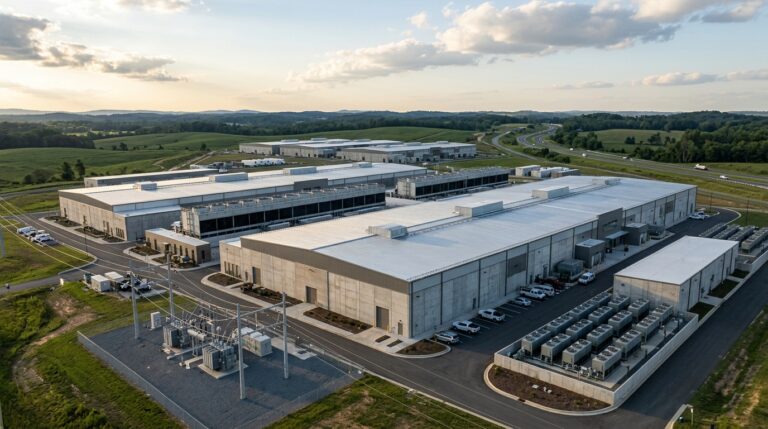
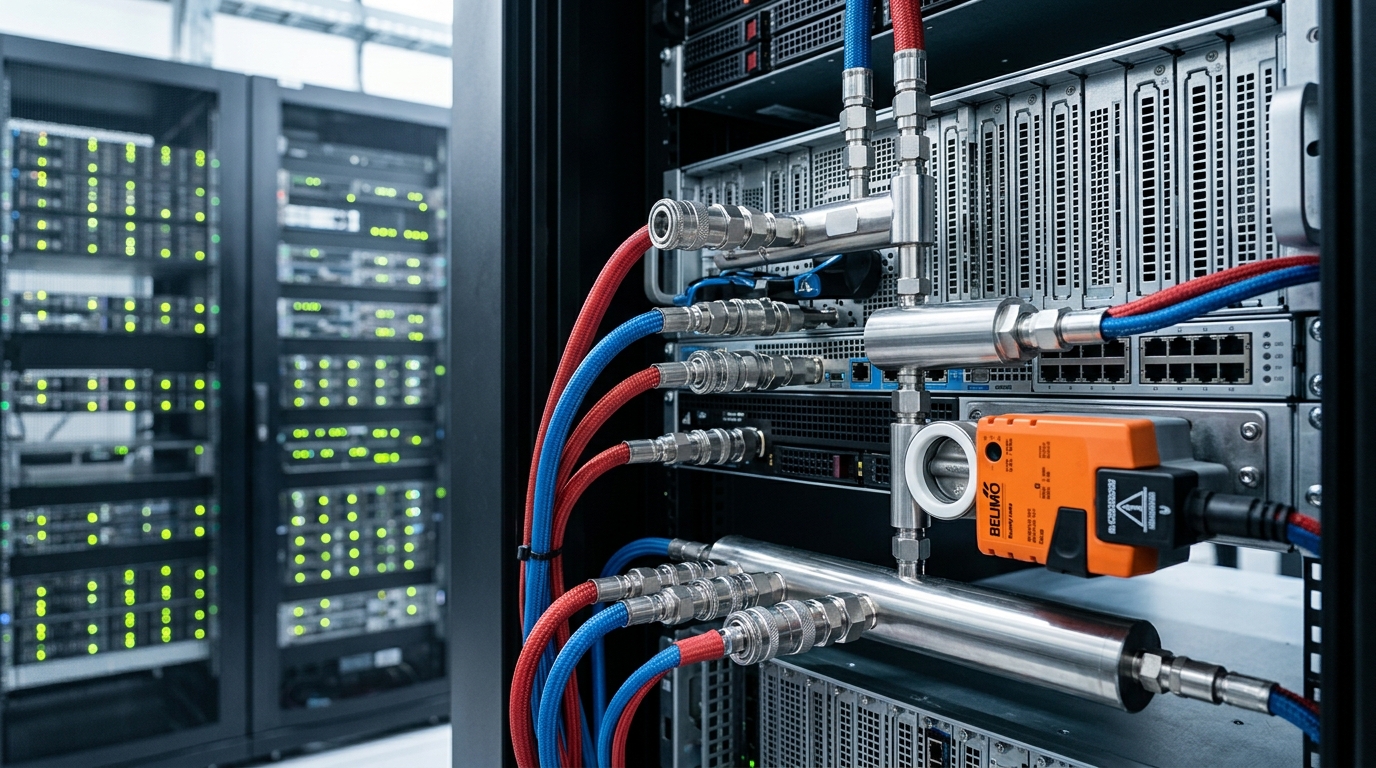
Every conversation about AI infrastructure lands on chips, power, or real estate. The companies actually setting the pace of deployment right now make valves, quick-disconnect couplings, and manifold assemblies. That is a live supply constraint visible in earnings reports most equity investors never open.
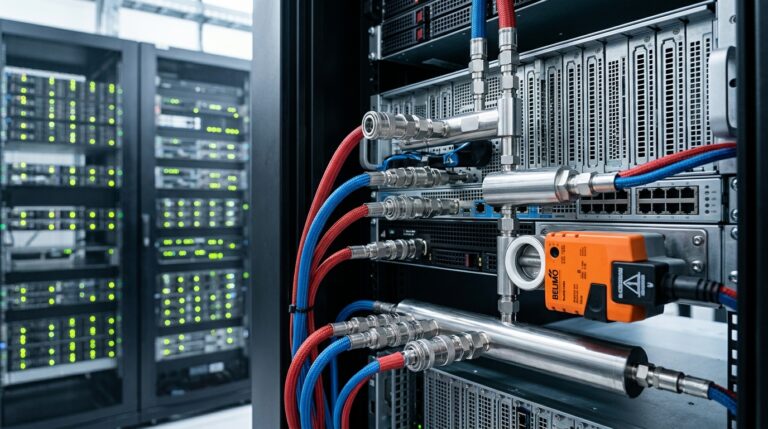
Belimo Holding, a Swiss HVAC field-device maker listed in Zurich, reported first-half 2026 sales of CHF 676.4 million, up 29.6% in local currencies. Data center cooling accounted for slightly more than half of that absolute growth. The Americas rose 35.1% and Asia Pacific 58.0%, both driven explicitly by AI investment. An EBIT margin of 22.5% says the company is not discounting to win business. Customers are paying for access.
Danfoss told a similar story in its first-half 2026 results. The Danish group reported first-half sales of EUR 5.3 billion on 15% organic growth, and it pointed to data center-driven growth in its Power Solutions business.
Why the Manifold Is the Bottleneck
The GB200 NVL72 rack draws approximately 120 kilowatts. Air cooling cannot remove that heat from a rack-scale enclosure under any practical engineering condition. The rack ships with liquid cooling manifolds integrated into the system.
Quick-disconnect couplings linking cold plates to manifolds face equally exacting demands. A single rack can require a large number of them; each must seal without a drop of coolant on disconnect and survive 5,000 or more mating cycles. Stäubli launched its next-generation LQD coupling in 2026 to address pressure-loss buildup where hundreds of connectors compound loop resistance. Parker Hannifin, CPC, and CEJN have aligned product lines around the Open Compute Project Universal Quick Disconnect specification. Supply remains concentrated among a handful of Western firms. A hyperscaler that cannot source them cannot commission racks.
Acquisitions Confirm the Thesis
Eaton paid $9.55 billion for Boyd Thermal in March 2026, at 22.5 times estimated adjusted EBITDA for 2026. Boyd forecast $1.7 billion in 2026 sales, of which $1.5 billion came from liquid cooling. Ecolab closed its $4.75 billion purchase of CoolIT Systems on July 2, 2026. Schneider Electric completed its acquisition of a controlling interest in Motivair on February 28, 2025. These are industrial and chemical process firms paying steep multiples because they believe the manifold, the valve, and the coupling are where margin lives once GPU supply normalizes.
The Overlooked Name
Parker Hannifin posted record fiscal 2026 sales of $21.5 billion and raised its adjusted segment operating margin target to 30% by fiscal 2031. In the fiscal 2026 earnings call, management said data center exposure is about 1.5% of sales, and it had previously described it as about 1%, growing fast through liquid cooling subsystems. Parker is almost certainly underweight in AI infrastructure portfolios relative to its actual role.
Risks and What to Watch
Standardization can work against incumbents. If the OCP UQD specification commoditizes, coupling pricing compresses as more manufacturers build capacity around the same interface. Acquisition multiples carry their own risk: 22.5 times EBITDA assumes sustained volume and margin that a fast-turning capital expenditure cycle could undercut.
The Supercomputing 2026 conference in Chicago (November 15 to 20, 2026) is the next concrete checkpoint, where Ecolab plans to debut its combined CoolIT and 3D TRASAR platform. Whether integrated fluid-chemistry holds the pricing that current acquisition multiples require is the question the whole sector has to answer.