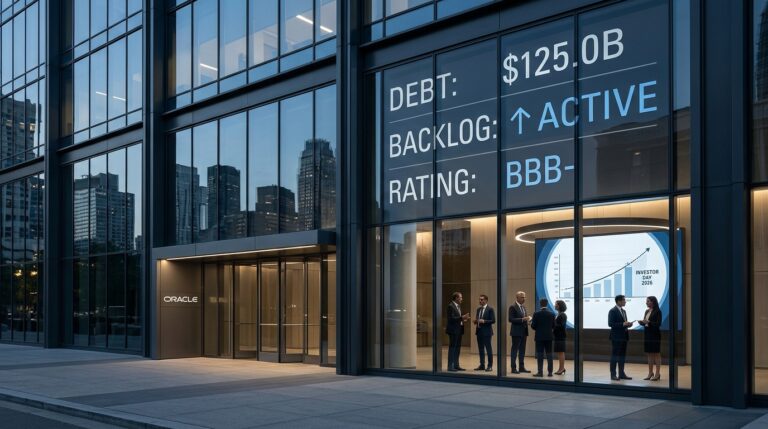
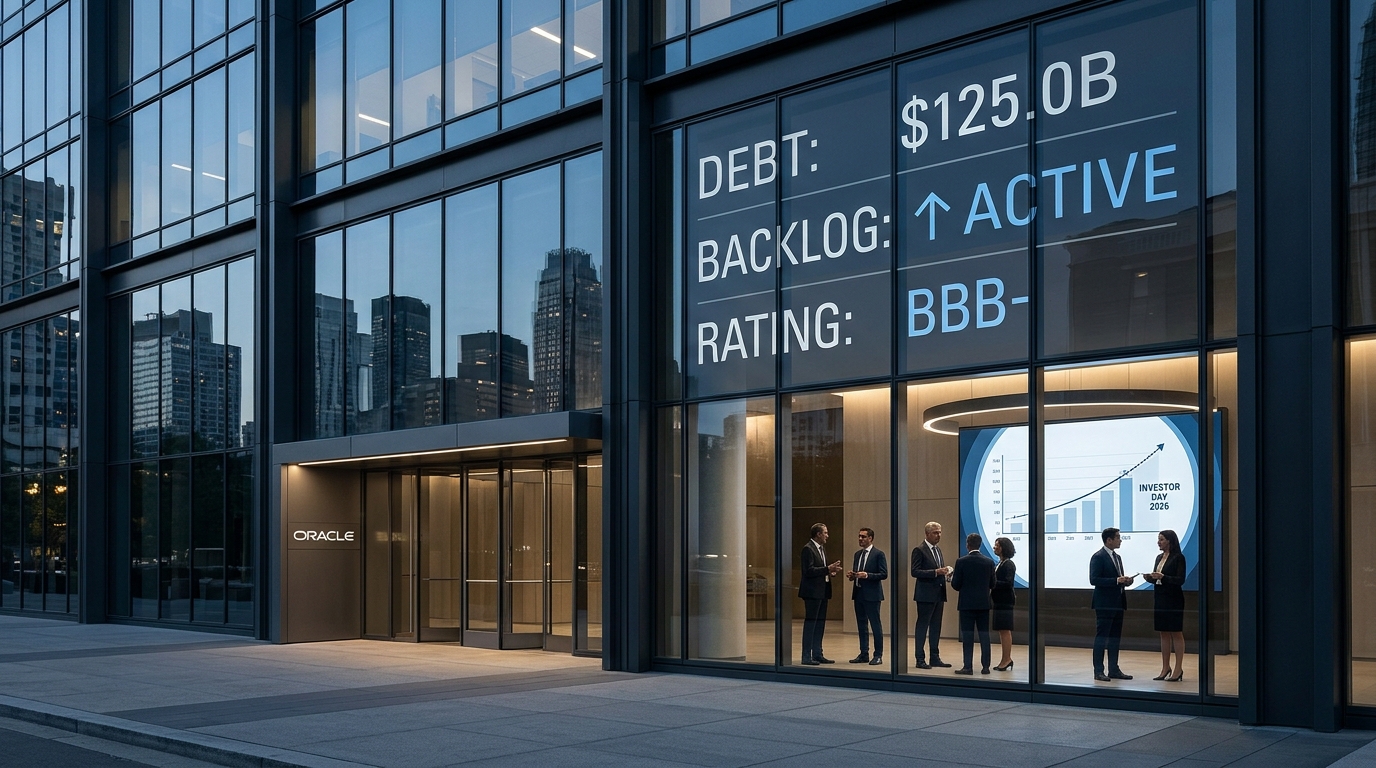
The word “crisis” sells short what is actually happening at Oracle. A crisis implies a company losing control. What Oracle’s balance sheet reflects, instead, is an enormous bet placed with borrowed money, one that is either the most disciplined infrastructure investment in enterprise software history or a leverage load the income statement cannot outrun.
The data is not ambiguous. As of August 31, 2026, Oracle’s notes payable and other borrowings, non-current stood at $117.7 billion, with a further $7.6 billion due within twelve months. Total reported debt reached $125.34 billion for the fiscal quarter ending June 2026. Fiscal 2026 capital expenditures came in at $55.7 billion against operating cash flow of $32.0 billion, producing free cash flow of negative $23.7 billion. By any traditional software-sector screen, those numbers disqualify Oracle from the investment-grade shelf.
Except Oracle is no longer a traditional software company. Q1 fiscal 2027 total revenues hit a record $19.3 billion, up 30% year over year, with total cloud revenues up 62% to $11.6 billion and cloud infrastructure alone up 121% to $7.4 billion. That infrastructure surge was powered by delivery of 850 megawatts of AI capacity and more than 300,000 GPUs to AI cloud customers, nearly triple Q4’s capacity. The revenue acceleration is real, and it matters directly to the debt question.
Where the Backlog Reframes the Leverage
Remaining performance obligations reached $638 billion at fiscal year-end, up from $138 billion a year earlier. That last figure is the structural argument bears ignore: Oracle is carrying debt against revenue it will recognize years from now, not quarters from now. The company ended fiscal 2026 with $31.3 billion of cash and cash equivalents, providing a foundation for near-term debt service.
The credit market is not fully persuaded. Oracle’s five-year CDS spread has been reported around 200 basis points in recent months, still signaling materially higher perceived risk than a plain-vanilla investment-grade profile. S&P cut Oracle to BBB- in July 2026. That rating sits exactly one notch above non-investment grade, leaving limited buffer.
The Scenario That Resolves This
Oracle raised full-year fiscal 2027 guidance to at least $90 billion in revenue with non-GAAP EPS of $8.10. If that guidance holds, operating cash flow scales with it, and the capex-to-revenue ratio begins to compress, the debt burden becomes self-liquidating over a three-to-five year horizon. Q1 capex alone ran $28.5 billion, 51% of the entire fiscal 2026 total, and free cash flow was negative $5.4 billion. The pace has to moderate for the math to close.
The scenario that does not resolve cleanly: AI demand softens, backlog conversion rates disappoint, and Oracle faces a rating action that forces index-mandated selling of its bonds. A downgrade to non-investment grade would compel funds restricted to investment-grade holdings to exit positions. That is a liquidity event, not an operating one.
What Wednesday Changes
Oracle’s investor day falls on October 28, 2026, and its credit profile has rarely been under this much scrutiny. The mix of debt versus equity in any planned capital raise will shape sentiment directly: more equity eases leverage concerns, while more debt adds to an already heavy load. Traders positioned in ORCL equity or holding long duration in the bonds need a clear capex trajectory and a credible path to positive free cash flow before that matters less than the backlog. Wednesday is where Oracle gets to make that case.