Here is a number that stops you cold. SoftBank’s $99.6 billion reported fair value for its OpenAI stake now represents roughly 70% to 75% of the company’s entire market capitalization, depending on the day. That means every other asset Son has assembled, an 86% position in Arm Holdings, a domestic telecom, stakes in T-Mobile and Coupang, is collectively worth, in the market’s eyes, far less than it should.
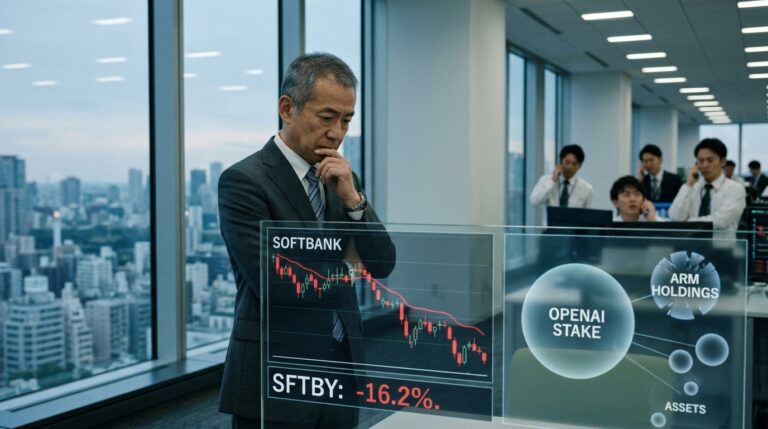
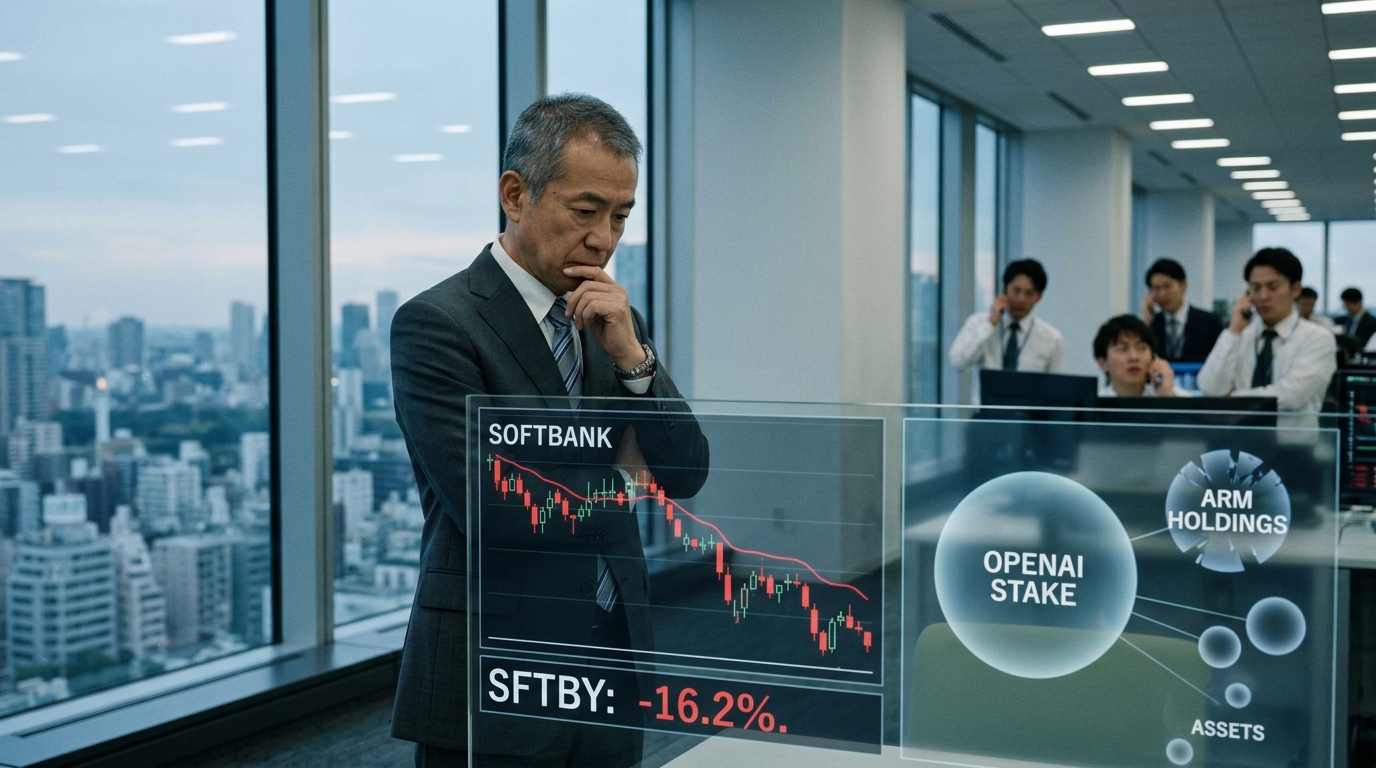
That is the real story behind Friday’s selloff. SoftBank Group suffered a sharp 16.16% decline, marking its largest single-day drop in over two years. The stock is now down sharply in November after a steep drop in October.
What Triggered It
The proximate cause was Anthropic’s Wall Street debut. Anthropic jumped 17% in its Nasdaq debut, trading under the ticker “ANT,” after the company raised about $81.3 billion in the IPO. At Thursday’s close, Anthropic had a fully diluted market cap of roughly $1.8 trillion. A rival AI company, backed by Google and Amazon, had just priced itself at a figure that made OpenAI’s private valuation look like a question rather than a fact.
SoftBank’s founder, Masayoshi Son, expressed regret for not investing in Anthropic, having previously committed substantial funds to competitor OpenAI. That admission landed badly. It underscored that SoftBank bet entirely on one side of the AI race, and the other side just went public at nearly $2 trillion.
The Parts Under the Hood
Start with Arm. SoftBank Group holds an indirect stake of roughly 86% in Arm, making Arm a controlled company under Nasdaq rules. ARM’s stock trades at $182.76, down 60% from its 52-week high of $452.70, reflecting significant recent volatility. Arm reported a record second-quarter fiscal 2027 revenue of $1.44 billion, a 27% increase from the prior year, with non-GAAP earnings per share rising 33% to $0.52. At its current price, Arm’s stake was worth about $187.7 billion on its own, more than SoftBank Group’s market value. The business is real and growing. The stock just got cut in half from its peak.
Then there is OpenAI. SoftBank’s cumulative OpenAI investment stands at $64.6 billion, for an ownership stake of about 13%. SoftBank carried its OpenAI stake at a fair value of $99.6 billion on September 30, against a cumulative investment of $54.6 billion, with no gain or loss recorded in the six months. The critical complication: OpenAI has delayed plans for an IPO to 2027, pushing out the liquidity event Son has been building toward. SoftBank arranged a $40 billion bridge facility to fund its OpenAI commitments, but it repaid the bridge facility in full about six months early, ahead of the March 2027 maturity. An IPO that arrives after that deadline, or not at all in that window, no longer creates the same refinancing problem.
Bull Case, Bear Case
The bull case is straightforward math. Add up the Arm stake at current prices, the OpenAI fair value, the telecom subsidiary, and minority positions in T-Mobile and Coupang, and SoftBank’s assets dwarf its market cap. If Anthropic’s debut ultimately forces a public re-rating of OpenAI closer to $1.5 trillion, SoftBank’s 13% slice alone would be worth something like $195 billion, roughly 1.8 times today’s market cap for the whole company. SoftBank’s November 10 earnings report revealed a second-quarter net loss of about $7 billion, weighed down by major U.S. data center costs and rising financing payments, but that is a cash flow problem, not an asset quality problem.
The bear case centers on what happens if Anthropic’s debut, rather than lifting OpenAI’s implied value, instead invites investors to question it. OpenAI is not Anthropic. It has a different revenue profile, a more complex cost structure, and no public market comps yet. Questions have grown over whether massive investments in AI infrastructure will generate sufficient returns. If those questions harden into skepticism before OpenAI lists, SoftBank is left holding an enormous illiquid position, even if the bridge facility itself is no longer the immediate choke point it once appeared to be.
What to Watch
Three things will determine whether today’s price is a floor or a way station. First, any update on OpenAI’s IPO timeline. Second, Arm’s royalty trajectory: Arm says demand for its Arm AGI CPU business supports its confidence in achieving up to $2 billion in Arm AGI CPU revenue across fiscal 2027 and 2028, and execution on that target would meaningfully shift the valuation calculus. Third, how Son funds future AI commitments, and whether that comes through asset sales, refinancing, or something else.
SoftBank is not a company in distress. It owns assets worth multiples of its market cap. But it is a company whose stock the market is treating as if the OpenAI position is the only thing that matters, and everything else is a liability. At ¥3,025, that is an aggressive read. It may also be an opportunity, provided OpenAI eventually shows up to its own public debut.