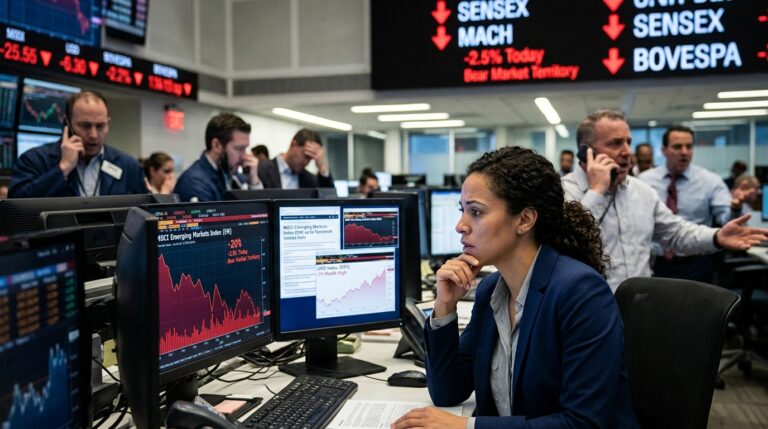
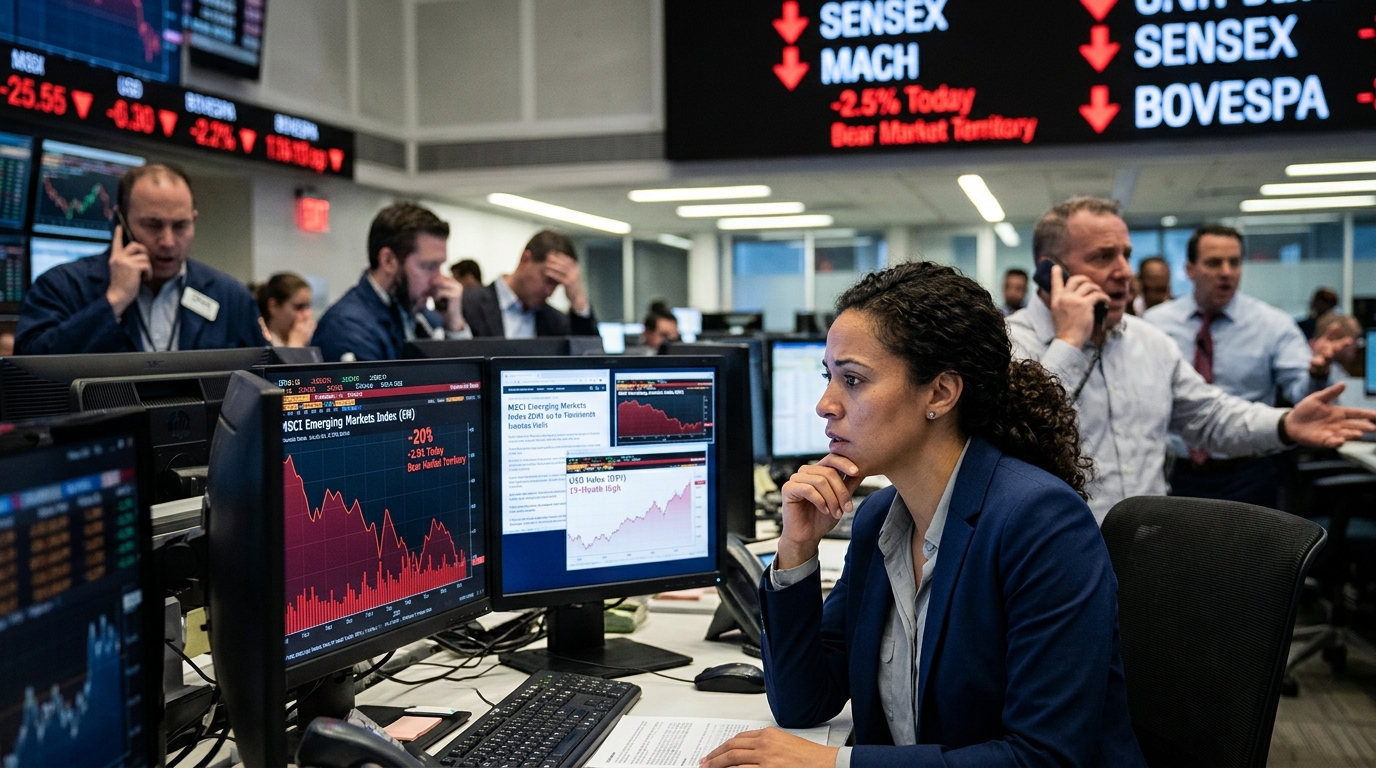
The number that matters most this Friday is not a single stock price. MSCI’s gauge of developing-nation equities has fallen more than 20% from its June peak, putting it in bear-market territory by the usual definition. Seven consecutive losing sessions. That is the scoreboard.
But the index alone understates the problem. The U.S. Dollar Index has spent the past week anchored near a 19-month high. DXY was roughly 103.8 on Thursday after Fed minutes showed nearly all Federal Reserve officials thought additional rate increases would likely be appropriate. A strong dollar is not incidental to the emerging-market selloff; it is the other half of it. When the dollar climbs on the back of a hawkish Fed, dollar-denominated debt becomes heavier, capital flows reverse toward U.S. assets, and local currencies weaken. The index and the currency are running the same play.
The AI-led rout hits the MSCI developing-country index hard because chip heavyweights Taiwan Semiconductor Manufacturing, Samsung Electronics, and SK Hynix are major constituents. Those three names are not peripheral holdings; they are a large part of the index. When sentiment toward AI hardware turns, emerging markets move with it.
Today’s damage in Taiwan is severe. Taiwan’s Taiex fell about 6.2% on Friday and finished the week down about 17.5%, according to Taiwan media and exchange tallies. Reports from Taiwan market coverage also put foreign selling on Nov. 18 at roughly NT$76.6 billion, part of a multiday outflow streak.
The selloff is not confined to semiconductors. Regional losses have spread beyond the chip complex as risk appetite breaks down.
For investors using EEM as their primary vehicle, the country exposure explains the pain precisely. Recent iShares reporting shows Taiwan at roughly 27% of the fund and South Korea near 18%. China is a large slice as well, but closer to about 19% than 21% in the latest fact-sheet style breakdown, meaning a big share of EEM sits in the markets most exposed to the hardware-led drawdown.
The counterargument deserves a fair hearing. Valuations in emerging markets were not stretched coming into this week, and the AI trade’s fundamentals, semiconductor demand and data center buildout, remain intact over a multi-year horizon. One strategist, Dilin Wu, framed the move as a valuation and positioning shock amplified by foreign selling and margin calls, rather than a clean break in end-demand. Forced liquidations can overshoot.
But the macro backdrop is not cooperating with a quick recovery. Fed minutes this week reinforced the bias toward additional tightening, with some officials even floating the possibility of a larger move at the December meeting. Until that changes, the currency and credit pressures on developing economies remain active headwinds, not past ones.
The near-term calendar carries the most weight. The Fed’s December meeting is now the central event. Any softening in U.S. inflation data before then could ease dollar pressure and stabilize EM currencies. Conversely, another upside CPI surprise would likely extend the DXY rally and deepen the gap between where MSCI’s gauge sits today and where it was in June. Watch the November PCE reading, due in two weeks, and watch TSMC’s forward guidance, which will tell investors whether the hardware cycle is slowing or simply being repriced.